Car Won't Start With a New Battery? What to Check First
Published Oct 23, 2026 · 6 min read · By Hassan, Owner of Roadmate Services
A brand-new battery and the same old silence is a special kind of Monday. If your car won’t start with a new battery, check the connection first: a loose or corroded clamp, cables on the wrong posts, or the wrong battery for the car. If those are fine, the alternator or the starter is next.
Quick answer: what to check, in order
| Check | What you see | Likely cause | Who fixes it |
|---|---|---|---|
| 1. Terminals | Clamp turns by hand, white or green crust | Loose or corroded connection | You (tighten, clean) or us |
| 2. Cable order | Red cable not on the + post | Reversed install | Stop. A mechanic checks fuses |
| 3. Battery label | Size, type or CCA differs from the old one | Wrong battery | Swap it |
| 4. European or newer car | Warnings or charging faults after the swap | Battery not registered | Scan tool |
| 5. Charge level | Slow crank, battery sat on a shelf or lights left on | New battery not fully charged | Jump, then a test |
| 6. Charging system | Battery light, dim lights, dead again in days | Alternator | Mechanic |
| 7. Start sound | Bright dash, one click or nothing | Starter, relay or fuse | Mechanic (tow) |
| 8. Engine, fuel, security | Cranks but never fires, or security light flashes | Fuel, key or engine fault | Mechanic |
| In short | Connections first | Then charge, alternator, starter | Most fixes start in the parking lot |
A new battery is a fresh heart for the car. It still needs the arteries connected.
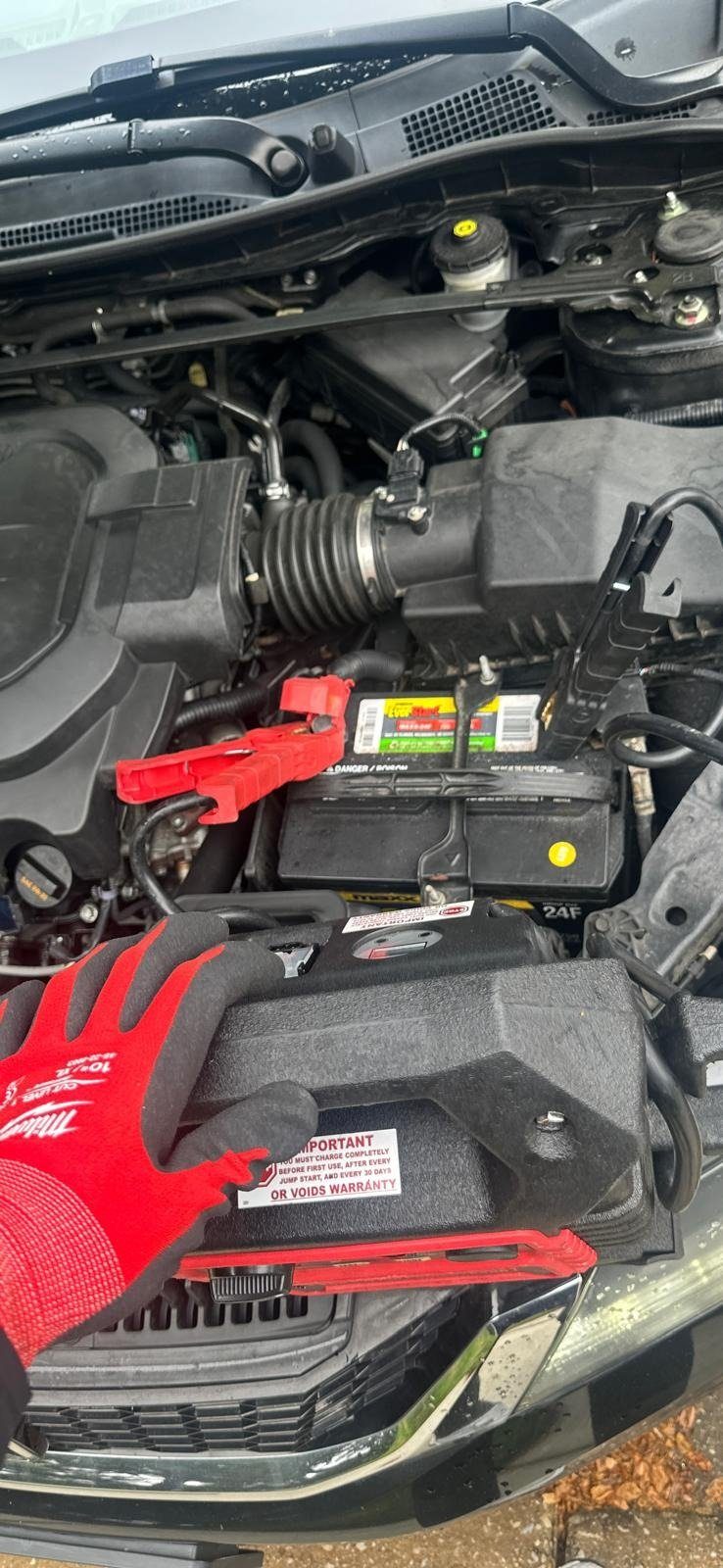
Car won’t start after battery replacement: check the install first
1. Loose or corroded terminals
Try to twist each clamp by hand. If it moves, it is too loose to carry starting current. Clean any white or green crust off with a wire brush, then tighten. The battery is new; the clamp may be from 2014 and have opinions.
If you take the clamps off to clean them, do it in the right order. Our guide on which battery terminal to disconnect first walks through it.
2. Cables on the wrong posts
The red cable goes on the positive (+) post and the black cable on the negative (−) post. If they were swapped, stop and do not try to start the car again. Firestone warns that reversed cables can blow fuses and damage the engine computer. Fix the connections, then have a mechanic check the fuses and electronics before driving.
3. Wrong battery size, type or CCA
Compare the new battery’s label with the owner’s manual: group size, type and cold cranking amps (CCA). Many start-stop cars need an AGM battery, and a battery too small for the engine may crank slowly on the first cold Ohio morning. Close enough works for horseshoes, less so for batteries.
4. Battery registration on some cars
BMW and other European vehicles, and many newer cars, adjust charging to the battery’s age. After a swap, the new battery is registered with a scan tool. As Midtronics explains, an unregistered battery can be charged wrongly, and some cars show warning lights or electrical faults.
On a BMW X4 we replaced, booked about 2 hours ahead, the installation took about 30 minutes and the new battery then needed registering, as on other European vehicles. We did that on site. Until then, the car is like a new phone with no SIM card: shiny, not fully set up.
New battery, car won’t start: was it fully charged?
“New” does not always mean full. A battery can lose charge sitting on a shelf, a light left on during the swap can drain it, and a parasitic draw (something pulling power with the car off) can empty even a healthy battery overnight. A jump, a proper drive and a test tell you which. A trip to the mailbox does not count as a proper drive.
Symptoms of a bad alternator with a new battery
If the new battery goes flat again, the alternator, which charges it while the engine runs, is the usual suspect. Watch for:
- The battery warning light comes on while driving.
- Headlights and dash lights dim, or flicker as you rev.
- The car starts after a jump, then dies within minutes.
- The new battery is dead again within days.
AAA notes that a car which dies within 10 to 15 minutes of starting points to the alternator, and that a running engine should show about 13 to 14.5 volts at the battery. More signs are in our guide to the signs of a bad alternator. Putting a new battery on a bad alternator is like refilling a bathtub with the plug out.
Clicks but no crank: starter, relay or fuse
Bright dash lights with one click, or nothing, usually mean the power is there but the starter, its relay or a main fuse is not passing it on. Our page on a car that clicks but won’t start explains the sounds.
Not everything is a roadside job, and we will say so. A failed starter is not repaired on site; the car goes to a mechanic on a tow. No amount of new batteries will talk a tired starter into one more shift.
Rare but serious: engine, fuel or security problems
If the engine cranks normally but never fires, the battery is doing its job. The cause is more likely fuel, a key the car does not recognize (watch for a flashing security light) or, rarely, an engine fault. That is mechanic work. Try your spare key first; it is the cheapest test on this page.
What we do on the call in Columbus
- Jump start: $75 to $150, estimated. After the jump we test the battery, the alternator and the charging system, not only the battery.
- Battery replacement: quote by phone. We fit DieHard batteries and carry common sizes on the truck, so a wrong battery can be swapped where the car is parked.
- Registration: done on site for cars that need it. Our technicians carry a scan tool, though it cannot always fully diagnose a fault on site.
- Tow to a mechanic: $125 to $275, estimated, for tows of about 1 to 15 miles, if it turns out to be the starter or the alternator.
We work 6 AM to 8 PM daily, Eastern Time, and arrive in about 32 minutes on average, depending on traffic, weather and location. See our jump start service in Columbus page. Plenty of these calls end with a tightened clamp and a slightly embarrassed engine.
Frequently asked questions
How do you tell if it is the starter or the battery?
With a weak battery, the dash dims and the engine cranks slowly or clicks rapidly. With a bad starter, the lights stay bright and you hear one click or nothing. If a jump does not change anything, the starter is the more likely cause.
Why is my battery good but my car won't start?
The power is not reaching the starter, or the starter is not using it. Check the clamps first, then a blown main fuse, the starter relay and the starter itself.
Why is my car dead after a new battery?
Usually the battery was never fully charged, something was left on, or the alternator is not charging it. Test the charging system before buying a second battery.
Can I start my car right after putting a new battery in?
On most cars, yes, once both clamps are tight and on the right posts. Some cars, including many BMW and other European models, need the new battery registered with a scan tool so the car charges it correctly. Your owner's manual says whether yours does.
Can a new battery be bad out of the box?
Yes, but it is rare. A battery can also be weak because it sat on a shelf for months. A battery test settles it, and a faulty new battery should be covered by its warranty.
The bottom line
When a car won’t start with a new battery, the battery is rarely the problem. Check the clamps, cable order and battery type first, then a low charge, the alternator and the starter. Some cars also need the new battery registered.
New battery, still stuck in Columbus?
Call (380) 288-2822, 6 AM to 8 PM daily, Eastern Time. We jump the car, test the battery, alternator and charging system, and tell you honestly whether it is a parking-lot fix or a trip to a mechanic.
Here is to your next turn of the key sounding like an engine that read the manual.