Can You Drive on a Flat Tire? Only Far Enough to Get Safe
Published Oct 23, 2026 · 5 min read · By Hassan, Owner of Roadmate Services
Can you drive on a flat tire? Only as far as the nearest safe place to stop, slowly, with your hazards on. Every extra stretch can turn a repairable tire into a replacement and damage the wheel too. A flat turns any short drive into a slow, noisy parade with an audience you did not invite.
Quick answer: driving on a flat tire at a glance
| Situation | Can you drive on it? | Do this |
|---|---|---|
| Flat on the highway | Only to the shoulder or next exit, slowly | Get safe, then call |
| Flat in a lot or driveway | No | Fit the spare or get it repaired on site |
| Low but still holding air | A short, slow trip to air | Fill to the door-label pressure, look for a nail |
| Run-flat tire | Limited distance and speed | Check the manual or sidewall |
| Torn or bulging sidewall | No | Replacement tire |
| In every case | Stop as soon as it is safe: the shorter the drive, the better the chance of a repair. | |
Flat tire on the highway? Get safe, then call
- Turn on your hazard lights and ease off the gas. Do not brake hard.
- Roll slowly to the shoulder, the next exit or a parking lot.
- If you cannot get fully off the road, stay buckled in with your hazards on and call for help. Give the highway, direction and nearest exit or mile marker.
- If you are in danger or anyone is hurt, call 911 first.
- Never change a tire on the traffic side of a highway shoulder.
On I-70, I-71 or I-270, safety comes before speed: a ruined tire costs less than standing next to traffic. See NHTSA’s roadside safety page.
What driving on a flat tire does to your car
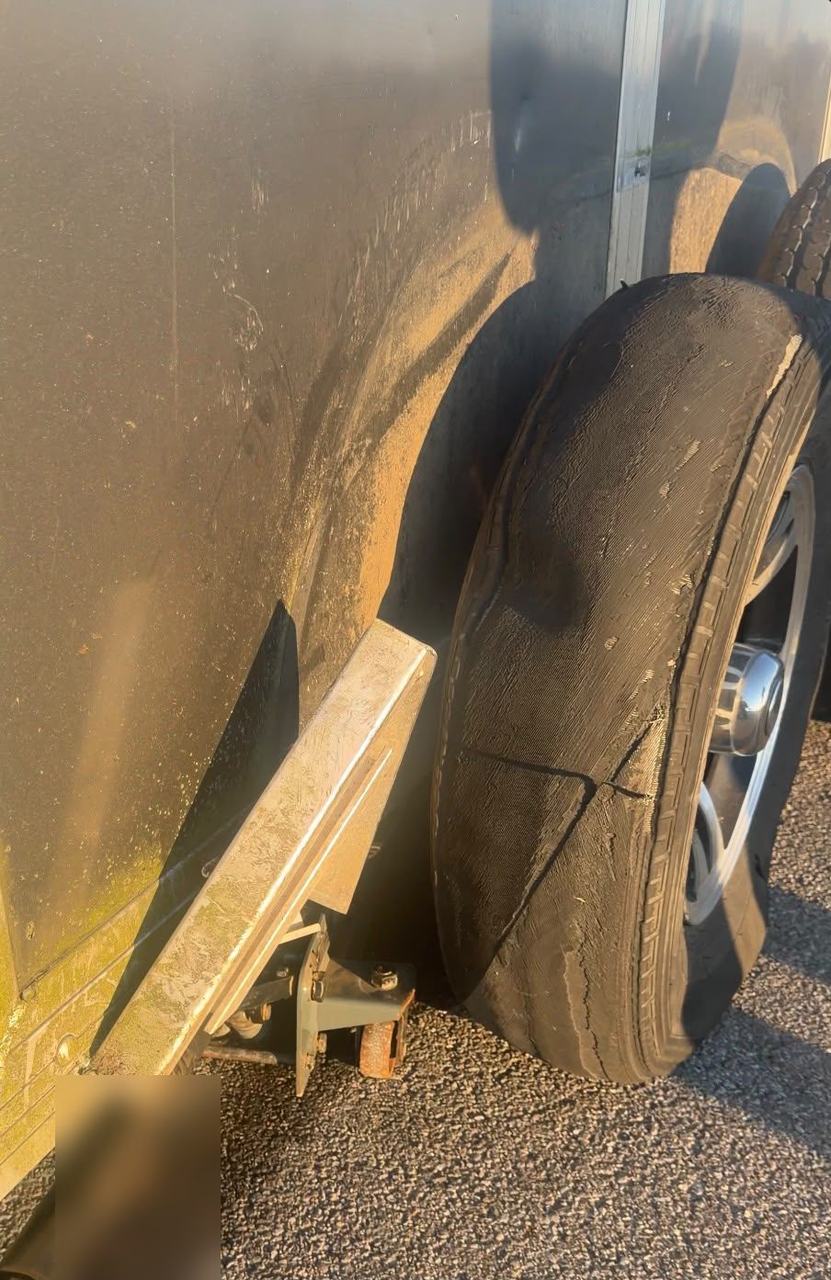
- The sidewall: it folds and grinds against itself, and sidewall damage cannot be repaired.
- The wheel: the rim can scrape the road and bend.
- Handling and braking: the car pulls to one side and takes longer to stop.
Below is a cargo trailer tire that kept rolling after it went flat. It is not a tire anymore; it is modern art.
Can I drive on a flat tire for 1 or 2 miles?
There is no safe mileage for a flat. A mile or two at low speed may get you off a busy road, but it may also cost you the tire, because the sidewall breaks down inside where you cannot see it. If you are already somewhere safe, stay there. Help can travel to the tire faster than the tire can limp to the shop.
Run-flat tires: the exception, with limits
Run-flats keep going for a while without air, but your owner’s manual or the sidewall sets the limit. As one manufacturer figure, Bridgestone rates its DriveGuard run-flats for up to 50 miles at up to 50 mph after a puncture. Many of these cars carry no spare, so that limit is your whole plan B. We repair and replace run-flat tires.
What to do instead of driving on a flat
- Fit the spare if you are somewhere safe. Our guide to changing a flat tire safely walks through it. Then see how long you can drive on a spare.
- Use a sealant kit for a small tread puncture only.
- Get it repaired on site. A plug works in most cases for a tread puncture. See which punctures can be repaired.
- Get a replacement tire. If it cannot be repaired and there is no usable spare, we take the tire to a shop, get it replaced and bring it back to fit it.
- Check your pressure monthly. NHTSA recommends it, spare included, even the one nobody has looked at since the car was new.
Flat tire in Columbus?
An on-site tire repair is typically $75 to $150. A tire change with your own spare is typically $85 to $175. You see the price before you confirm. We work 6 AM to 8 PM daily and arrive in about 32 minutes on average, depending on traffic, weather and location.
One school morning, a grandmother in Columbus found a flat on her Lexus before driving her grandson to school. She did not drive on it. We came to fit the spare, found a nail in the tread and repaired it in about 15 minutes instead. See our mobile tire service in Columbus.
Frequently asked questions
Can I drive my car if one tire is flat?
Only far enough to reach a safe place to stop, slowly, hazards on. Then fit the spare or call for help.
Can I drive 1 or 2 miles on a flat tire?
Only to get off a busy road. A mile or two on a flat can damage the sidewall and rim, and a damaged sidewall cannot be plugged.
How long can you drive on a run-flat tire?
Check your owner's manual or the tire's sidewall. Bridgestone, for example, rates its DriveGuard run-flats for up to 50 miles at up to 50 mph after a puncture.
Can a tire be repaired after driving on it flat?
Often not, if the sidewall was damaged. A tread puncture in a tire that was stopped quickly can usually be plugged.
The bottom line
Drive on a flat only as far as a safe place to stop, slowly, hazards on. On a highway, get safe, then call. Stopping early keeps a repair possible. As Hassan says, you cannot plan a flat; good tires prevent some, and the rest always pick the wrong moment.
Need a flat tire fixed where you are?
Call 6 AM to 8 PM daily. A dispatcher confirms availability, your full price and an arrival estimate before anyone heads your way.
Drive safe, and may your tires stay round and boring.