Smoke Coming From Under the Hood but Not Overheating: What to Do
Published Oct 23, 2026 · 6 min read · By Hassan, Owner of Roadmate Services
Smoke coming from under the hood when the engine is not overheating usually means something is burning on a hot part: oil, coolant, wiring, or debris caught on the exhaust. A normal temperature gauge does not make it safe. Pull over as soon as you safely can, turn the engine off and treat it as a possible fire until you know it is not.
Quick answer: what the smoke is telling you
| What you see or smell | Most likely | What to do |
|---|---|---|
| Thin white wisps after rain or a car wash, no smell | Water turning to steam | Watch it; it should fade within minutes |
| Blue-grey smoke, burnt oil smell | Oil on the exhaust or engine | Pull over, engine off, mechanic |
| White smoke with a sweet smell | Coolant on hot parts | Pull over, engine off, keep the cap shut |
| Dark smoke, burning plastic or rubber smell | Wiring, debris or a bag on the exhaust | Pull over, engine off, get out |
| Any flames, or smoke that keeps growing | A fire | Everyone out and well away, call 911 |
Smoke or flames from under the hood: what to do first
These steps follow the U.S. Fire Administration’s vehicle fire safety advice. On a highway the rule is the same as for any breakdown: get safe, then call.
- Signal and pull over as soon as it is safe, as far from traffic as you can. An exit or a parking lot is better than a narrow shoulder, if you can reach it safely.
- Turn the engine off.
- Get everyone out, on the side away from traffic.
- Move well away from the car. The USFA says at least 100 feet, and well away from traffic.
- Call 911 if you see flames or the smoke keeps coming.
- Do not open the hood if you think there is a fire under it. Opening it lets air in.
- Do not go back for a phone, a bag or anything else. Burning vehicles can trap people quickly.
For where to stand and how to get out on a highway shoulder, see what to do when your car breaks down on the highway.
Should you use a fire extinguisher?
The USFA’s advice is not to fight a car fire yourself. If you carry an extinguisher, the NFPA’s rule for using a portable fire extinguisher is strict: only a small fire that is not growing, only after everyone is out and 911 has been called, and only with a clear way out behind you. If the fire grows or you are unsure, leave it and move away.
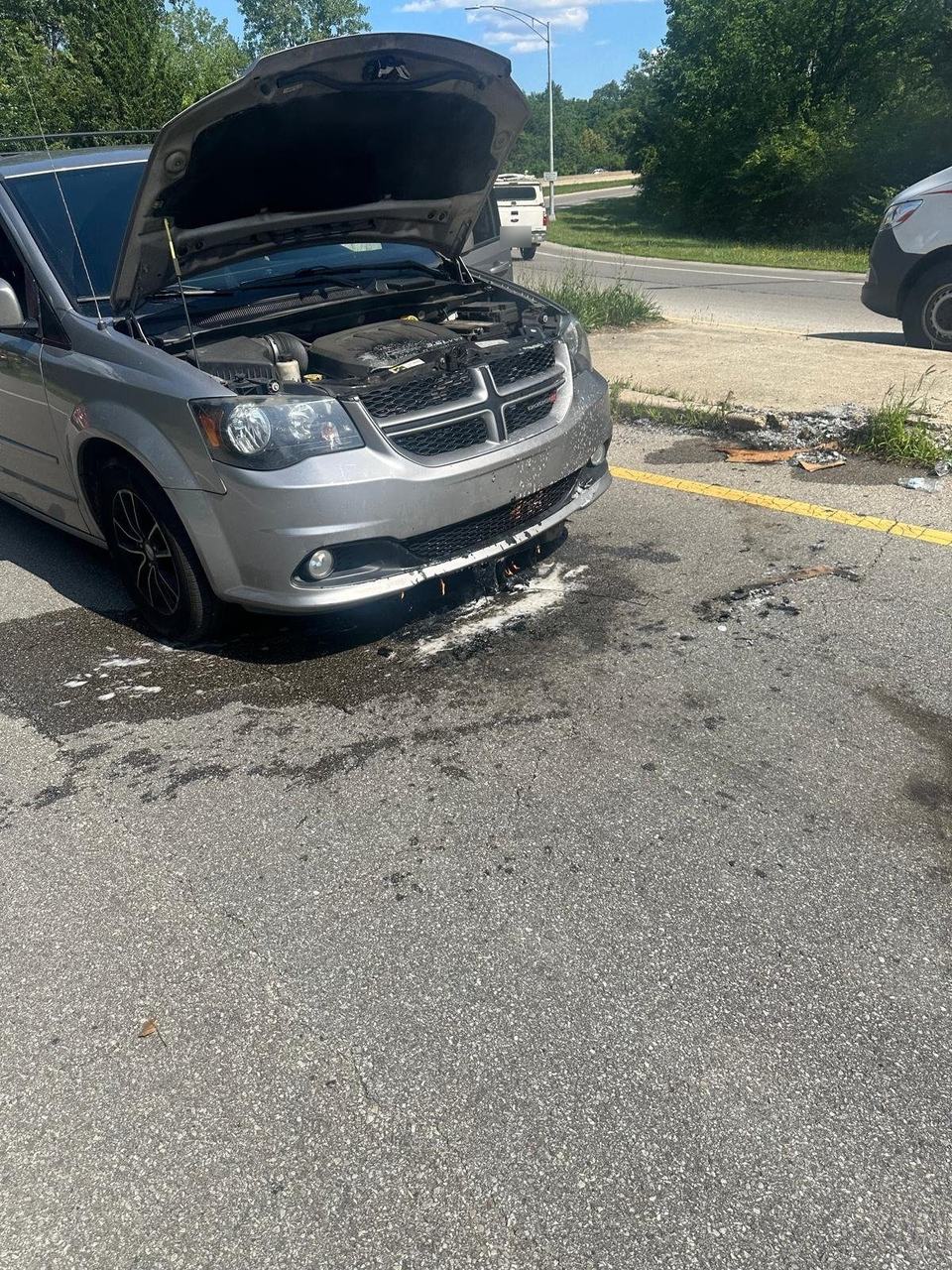
Here is what happened to me: cardboard under the car, then smoke
I was driving my own minivan on the highway when a piece of cardboard from the road got stuck under it. It was loud, and I could smell smoke. At first I thought the smell was coming from the road.
I took the exit to pull the cardboard off. A driver passing by told me my car was smoking. I did not have a fire extinguisher in the car. One driver stopped, but his extinguisher did not work. A second driver stopped, and his extinguisher put the fire out.
A woman who had driven past came back about 10 minutes later with 10 small water bottles, just to help. An ambulance arrived, but by then it was over. No one was hurt. The front wiring harness had burned and had to be replaced.
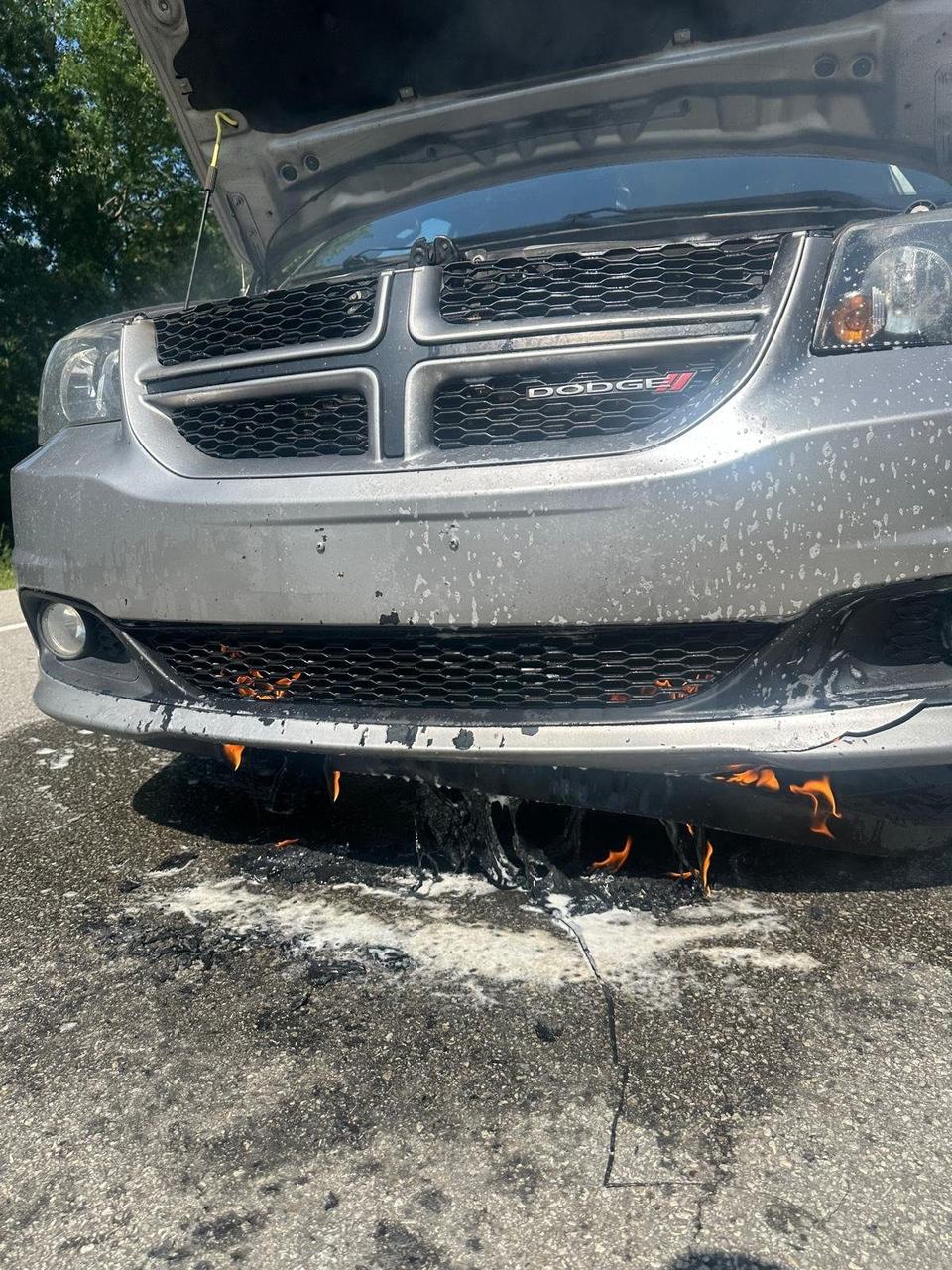
The hood is up in these photos. If you ever see flames, keep it closed and step away.
I took two lessons from it. A smell of smoke or a loud scraping noise from under the car is a reason to pull over safely and check, not to keep driving. And keep a working fire extinguisher in the car, and check it now and then: I had none, and the first one offered did not work. Make it part of your emergency car kit.
Strangers stopped, one after another, to help someone they did not know. That made the difference.
Why is smoke coming from under the hood if the car is not overheating?
The temperature gauge measures the coolant. It says nothing about oil on the exhaust or a melting wire. The USFA lists mechanical and electrical problems among the common causes of vehicle fires.
Oil dripping on the exhaust or engine
A leaking gasket, a loose oil filter or a filler cap left off can drip oil onto hot metal: blue-grey smoke and a burnt oil smell. Oil spilled during an oil change does the same briefly, then stops.
Coolant leaking onto hot parts
A small coolant leak can smoke before the gauge moves: white smoke and a sweet smell. Never open the coolant cap while the engine is hot. Our post on a coolant leak covers how to spot one.
Debris or a plastic bag on the exhaust
Cardboard, a plastic bag or leaves can catch under the car against hot parts, as on my minivan. A loud scraping or flapping noise is the early warning.
Electrical wiring
A short or damaged wire gives a sharp smell of burning plastic. Treat it as a fire risk.
Burning brakes or clutch smell
A sticking brake or a slipping clutch smells hot and acrid, often from a wheel rather than the hood. Let it cool, then have a mechanic check it.
Steam after rain or a car wash
Water on a hot engine turns to thin, white steam that fades within a few minutes. This is the one case that is usually harmless.
Smoke or steam: how to tell
| Sign | Steam | Smoke |
|---|---|---|
| Colour | Thin and white | Blue-grey, grey or black, thicker |
| Smell | None (sweet if it is coolant) | Burnt oil, hot plastic, rubber |
| How long | Fades in a few minutes | Keeps coming or gets worse |
When you cannot tell, treat it as smoke.
Can a car catch fire from overheating?
It can contribute. A very hot engine can split a hose or push out coolant or oil, and fluid landing on the exhaust can smoke or burn. If the gauge is in the red, stop and turn the engine off; our guide to why an engine overheats covers that case. Some cars have open recalls for fire risk; you can check your VIN on NHTSA’s recall lookup.
Car battery smoking
A smoking or hissing battery usually means overcharging, a short or a battery that has failed inside. Turn the engine off, get out and keep sparks and flames away: batteries give off flammable gas. Afterwards the battery needs replacing and the charging system needs a check.
Is it safe to drive with smoke from the hood? When it is a tow
Only light steam that fades is safe to drive on. Anything else goes to a mechanic on a tow truck. Not everything is a roadside job, and we will say so: smoke has to be found and fixed in a shop.
Once the fire service has cleared the scene, or there was never a fire, our tow service in Columbus is an estimated $125 to $275 for tows of about 1 to 15 miles; longer tows are quoted by phone. A car that is still leaking fuel is not one we tow; see what to do about a car leaking gas.
Frequently asked questions
Is it safe to drive if my car is smoking but not overheating?
Not until you know the cause. A normal gauge does not rule out burning oil, wiring or debris; only light steam that fades within minutes is harmless.
Can a car catch fire from overheating?
It can contribute: a very hot engine can push coolant or oil onto the exhaust. Do not keep driving with the gauge in the red.
Why does my car smoke after a car wash or in the rain?
Water on the hot engine turns to steam that fades within a few minutes. If it keeps going or smells, treat it as smoke.
Why is my car battery smoking?
Usually overcharging, a short or a battery that has failed inside. Turn the engine off, get out and keep sparks and flames away from it.
Should I open the hood if my car is smoking?
Not if there might be a fire; the U.S. Fire Administration says to leave it shut. With no flames or smoke, let the engine cool before you open it.
The bottom line
Smoke from under the hood with a normal gauge is still a reason to stop. Pull over safely, turn the engine off and get everyone out and away; with flames, call 911, keep the hood shut and do not go back. Light steam after rain is the only harmless case. Everything else needs a mechanic.
Need a tow to a mechanic in Columbus?
Get safe first, then call (380) 288-2822, 6 AM to 8 PM daily, Eastern Time. A dispatcher confirms the price and an arrival estimate before anyone heads your way. Average arrival is about 32 minutes, depending on traffic, weather and location.