Car Struggles to Start? Why It Happens and What to Do
Published Oct 23, 2026 · 6 min read · By Hassan, Owner of Roadmate Services
A slow crank is your car clearing its throat before a speech it may not finish. When a car struggles to start, the most common cause is a weak battery or a poor connection at the terminals. If the engine cranks at normal speed but takes a long time to fire, think fuel or ignition instead.
Quick answer: what the sound tells you
| What you hear or see | Most likely cause | What to do |
|---|---|---|
| Slow, dragging crank | Weak battery, cold, loose terminal | Jump, then test the battery |
| Normal crank, slow to fire | Fuel pressure, spark plugs, a sensor | Mechanic, or scan for codes |
| Single click, lights stay bright | Starter or its relay | Tow to a mechanic |
| Starts, then dies after a jump | Alternator or charging system | Test the charging system |
| Hard start only on cold mornings | Battery near the end of its life | Test it before winter |
| In short | Slow crank = power; slow fire = fuel or spark | Test before you replace parts |
If it starts on the third try every morning, that is not a personality quirk. It is the car asking for help politely, while it still can.
Why is my car struggling to start? 7 common causes
1. Weak or aging battery
The classic sign is a slow, dragging “rur-rur-rur” before the engine catches. AAA puts typical battery life at 3 to 5 years, so a slow crank on an older battery is rarely a coincidence. Our list of signs your car battery is dying covers the rest.
2. Loose or corroded battery terminals
A healthy battery cannot help much through a loose clamp or a crust of white or green corrosion. With the engine off, try to twist each clamp by hand. If it moves, it needs tightening. Turning the key harder does not add amps.
3. Cold weather
Cold mornings are one of the two most common reasons we get jump start calls. Cold thickens the oil and slows the battery, so the engine needs more power just as the battery has less. Our guide to a car that won’t start in the cold has the winter detail.
4. Worn starter
A slow crank with a battery that tests good often means a tired starter motor. If it sounds more like clicking than cranking, see car clicks but won’t start. A starter tends to retire without giving notice.
5. Alternator not recharging the battery
A failing alternator never fully recharges the battery, so each start gets harder. AAA and Les Schwab both note that a car which dies soon after starting points to the alternator. More on the signs of a bad alternator.
6. Fuel delivery: weak fuel pump, clogged filter, nearly empty tank
The engine cranks at normal speed but is slow to fire, because fuel arrives late or short. Fuel pumps do get recalled, so check the NHTSA recall lookup.
7. Ignition and sensors: spark plugs, coolant temperature sensor
Worn spark plugs give a weaker spark, so the engine needs several turns to catch. A faulty coolant temperature sensor gives the engine computer the wrong reading, so it mixes the wrong amount of fuel. The car is effectively dressing for summer in January.
Car hesitates to start but drives fine
A long crank in the morning, then a car that drives normally all day. With a healthy battery, the usual suspects are fuel pressure that bleeds off overnight, worn plugs or a sensor reading wrong. A scan tool reads stored fault codes; our technicians carry one, though it cannot always fully diagnose a fault on site. Your car is not a morning person, and there is a reason.
Starter or battery: how to tell
- Headlight test: turn on the headlights and try to start. Lights that dim hard and a slow crank point to the battery.
- Bright lights, one click or a slow crank anyway: the starter or its relay is more likely.
- Jump test: if a jump makes it start strongly, the battery side is the problem. If a jump changes nothing, think starter.
A jump alone does not prove the battery is bad. A delivery van driver once came back to his van at a Kroger parking lot in Columbus and it would not start. We arrived in about 30 minutes and the jump took under 2 minutes. The battery tested fine afterwards: he had left the lights on. That is why we test after every jump.
What to do when your car is struggling to start
- Turn off the headlights, heater, radio and anything plugged in.
- Try once or twice, keeping each try short, and rest between tries.
- Do not keep cranking. Long cranking drains the battery and can overheat and damage the starter.
- With the engine off and the key out, check that both battery clamps are tight and free of crust.
- If it still struggles, get a jump, then have the battery and charging system tested.
If you call us, tell the dispatcher what you hear (slow crank, normal crank, click), whether the dash lights dim, how old the battery is, and where the car is parked. That gets the right help to you faster.
When to call for a jump or a tow in Columbus
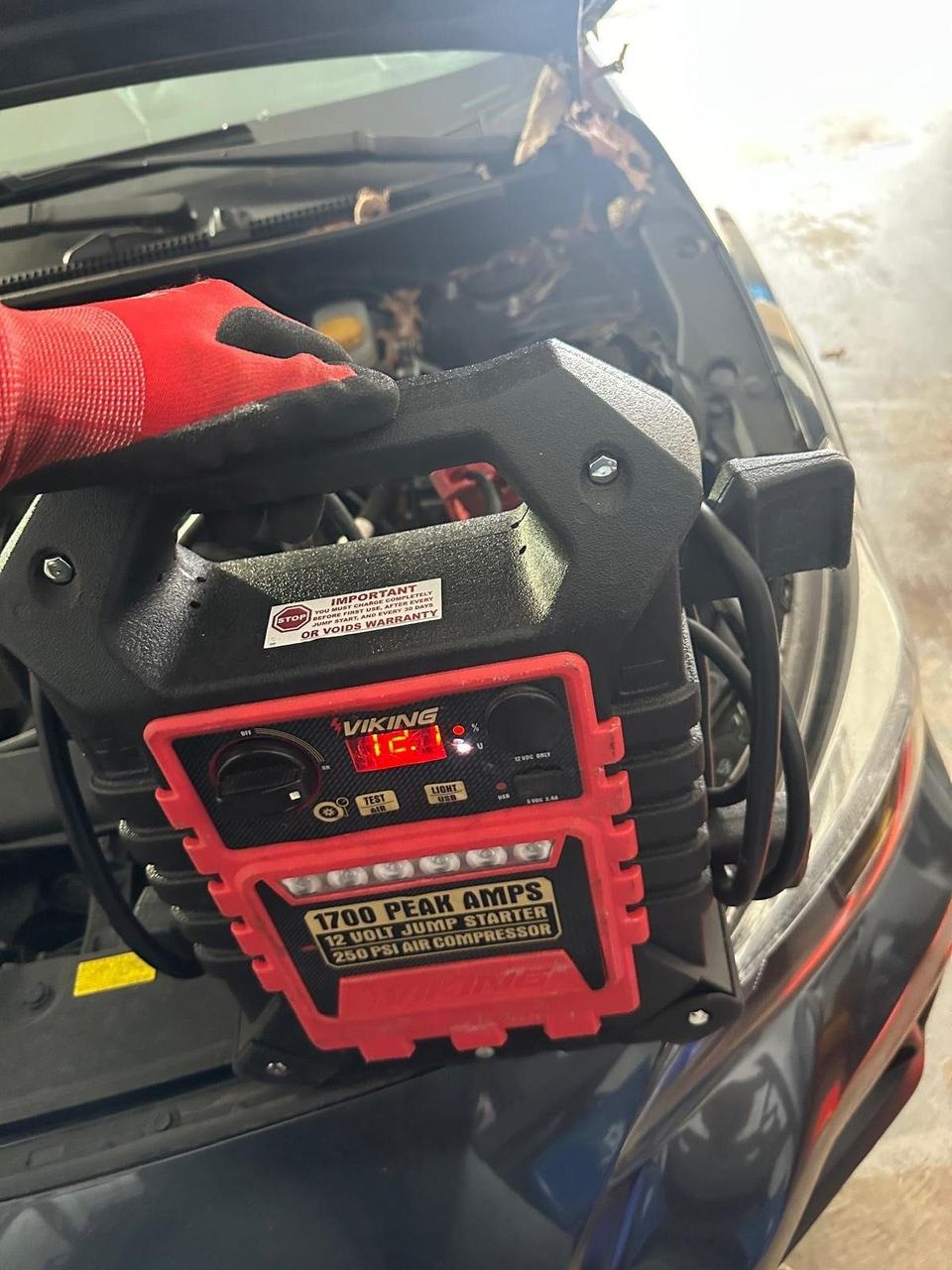
A slow crank from a weak battery is a roadside job. Our jump start in Columbus is $75 to $150, estimated. After the jump we test the battery, the alternator and the charging system, not only the battery, and if the battery is done we can replace it on site.
Not everything is a roadside job, and we will say so. A failed starter or fuel pump is a tow to a mechanic, not a roadside repair. A tow is $125 to $275, estimated, for about 1 to 15 miles.
We work 6 AM to 8 PM daily, Eastern Time, and arrive in about 32 minutes on average, depending on traffic, weather and location. Book through our jump start service in Columbus, or read our wider guide if your car won’t start at all. We would rather tell you it is a loose clamp than sell you a part you do not need.
Frequently asked questions
Why is my car struggling to start but drives fine?
If it cranks at normal speed but takes a while to fire, fuel pressure that bleeds off overnight, worn spark plugs or a faulty coolant temperature sensor are common causes. If the crank itself is slow, the battery or its connections are the usual suspects. A scan tool can read stored fault codes.
How do you tell if it is your starter or battery?
Turn on the headlights and try to start. If they dim hard and the crank is slow, the battery is weak. If the lights stay bright and you get one click or a slow crank anyway, the starter is more likely. A jump that changes nothing also points to the starter.
What should I do when my car hesitates to start?
Turn off the lights, heater and radio, then try once or twice with a short rest between tries. If it still struggles, get a jump and have the battery and charging system tested. Note what you hear, because it tells the mechanic or technician where to look.
Can cold weather make a car struggle to start?
Yes. Cold thickens engine oil and slows the chemistry inside the battery, so the engine needs more power just as the battery has less to give. A battery that is fine in September can struggle on the first frosty morning.
Is it bad to keep cranking a car that will not start?
Yes. Long cranking drains the battery and heats up the starter, which can damage it. Keep each try short, rest between tries, and stop after a few attempts. Your owner's manual gives the limit for your car.
The bottom line
A slow crank usually means the battery or its connections; a normal crank that is slow to fire points to fuel or ignition. Try a couple of short starts, do not keep cranking, and test the battery and charging system before you buy parts.
Car struggling to start in Columbus?
Call (380) 288-2822, 6 AM to 8 PM daily, Eastern Time. We jump the car, test the battery, alternator and charging system, and tell you honestly whether it is a parking-lot fix or a trip to a mechanic.
Here is to mornings where the engine answers on the first ring.