How to Test a Car Battery With a Multimeter
Published Oct 23, 2026 · 6 min read · By Hassan, Owner of Roadmate Services
A multimeter is about the cheapest second opinion your car will ever get. To test a car battery with a multimeter, set it to 20 V DC, touch the red probe to the positive (+) terminal and the black probe to the negative (−), with the engine off. A rested, fully charged battery reads about 12.6 volts or more. Around 12.2 volts means it is only about half charged.
Measure after the car has sat for at least an hour, so the number is real. Then run two more quick checks, cranking and charging. Together they tell you whether you have a flat battery, a worn-out battery or a charging problem.
Battery test at a glance
Readings in between? The full chart is in car battery voltage.
| Test | Engine | Healthy reading | If it fails |
|---|---|---|---|
| 1. Resting voltage | Off, rested at least 1 hour | About 12.6 V or more | Charge and retest. 12.0 V or less is deeply discharged |
| 2. Cranking voltage | Helper cranks the engine | Stays above about 9.6 V | Weak battery, or a starter or cable problem |
| 3. Charging system | Running at idle | About 13.7 to 14.7 V | Under 13 V: not charging enough. Over 15 V: overcharging |
| All three pass | Charged battery, working charging system | Only a load or conductance test confirms capacity |
General guides, not Roadmate figures. Sources: Clarios (resting and running ranges), Haynes (12.6 V healthy, rest an hour), K&K Richardson (9.6 V cranking). Checked October 2026.
Charts differ by a few tenths of a volt between sources, because temperature, battery type and surface charge all move the number. Ask three charts for the perfect voltage and you get three answers. You are looking for the big gaps, not the second decimal.
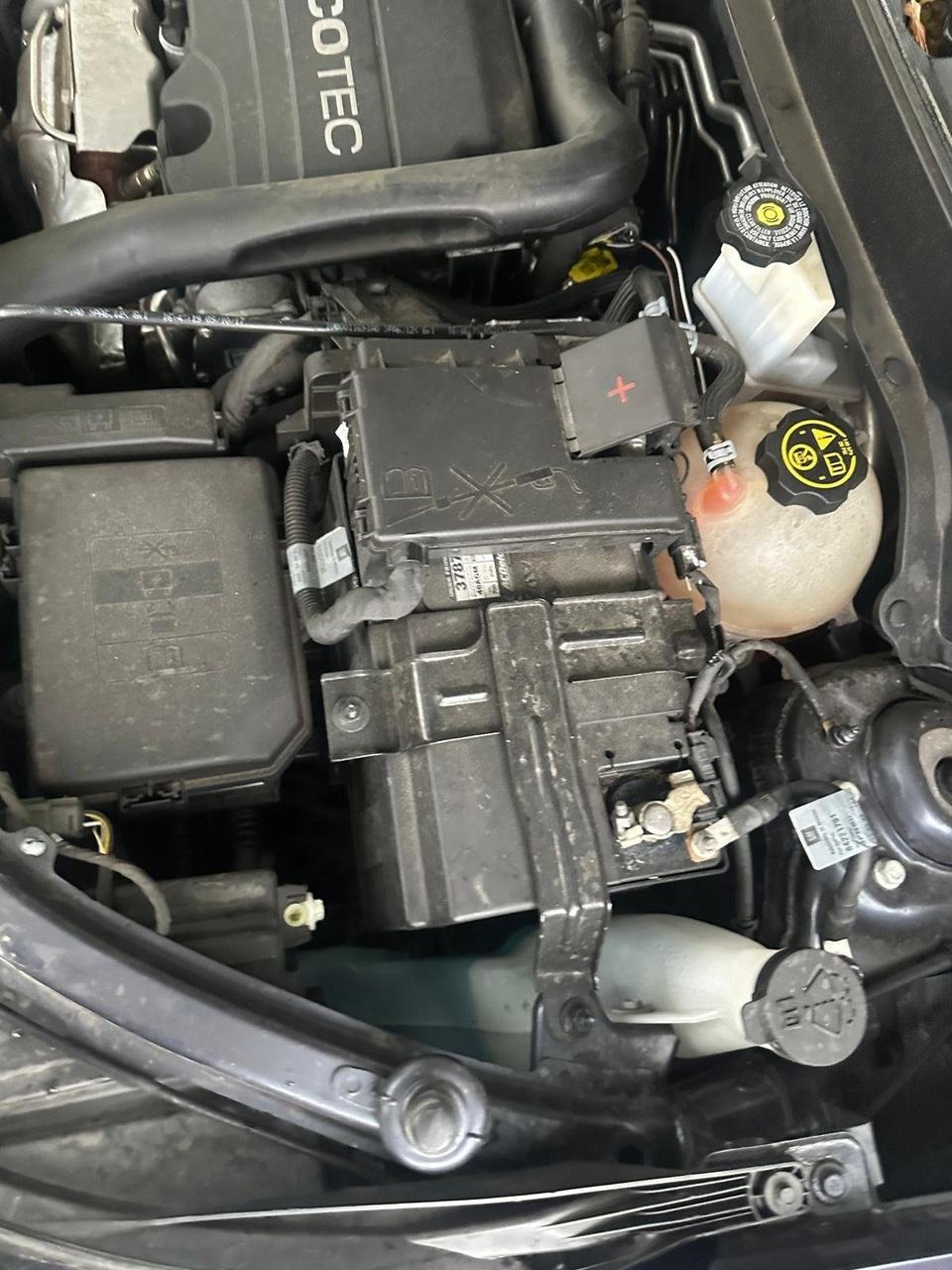
Before you start: multimeter setup and safety
Set the multimeter to 20 V DC
Any digital multimeter with a DC volts setting works. Plug the black lead into COM and the red lead into V. Turn the dial to 20 in the DC volts section (a V with a straight line), which reads 0 to 20 volts. On an auto-ranging meter, just pick DC volts.
If the screen shows minus 12.6, the battery is not in debt. The leads are swapped.
Let the surface charge settle
A battery that was just driven or charged reads higher than it really is for a while. Haynes says to wait at least an hour, and overnight is better. In a hurry? Interstate Batteries suggests turning the headlights on for about two minutes, then off, before you measure. Surface charge is the battery showing off for its first few minutes. Let it settle down.
Safety first
- Wear gloves and safety glasses. Batteries hold acid and give off hydrogen gas, so no smoking or sparks.
- Do not test a battery that is swollen, cracked or leaking. Leave it alone and call a professional.
- Keep the probe tips apart. Never let a probe or a tool touch both terminals at once.
- With the engine running, keep hands, sleeves, hair and leads clear of the fan and belts.
Test 1: measure battery voltage with a multimeter, engine off
- Turn everything off: engine, lights, radio. Close the doors so the interior lights go out.
- Lift the cover off the positive terminal. If there is crusty corrosion, the probe needs bare metal.
- Touch red to positive (+) and black to negative (−). The battery can stay in the car.
- Read the number and write it down.
Clarios rates 12.4 to 12.6 V at about 75% charged, 12.2 to 12.4 V at about 50%, and 12.0 V or less as deeply discharged. Cold lowers the reading a little: K&K Richardson notes that a battery reading 12.6 V on a warm day may show about 12.4 V at freezing.
A low number here is not a verdict yet. Charge the battery fully and test again; our guide on how long to charge a car battery has the times. A flat battery deserves a full tank before it takes the exam.
Test 2: cranking voltage, should stay above 9.6 V
This one needs a helper. Leave the probes on the terminals and have someone crank the engine for a few seconds while you watch for the lowest number. A healthy battery stays above about 9.6 volts, per K&K Richardson.
If a charged battery dips below 9.6 V, it is weak. If the voltage holds up but the engine only clicks or turns slowly, look at the starter and cables instead; see car clicks but won’t start. And if the engine simply starts during the test, that counts as a pass. Nobody has ever complained about that result.
Test 3: charging system test, engine running (13.7 to 14.7 V)
Start the engine and let it idle with the lights and fan off. Put the probes back on the terminals, keeping clear of the belts. Clarios puts a normal running reading at 13.7 to 14.7 volts.
Under 13 V, the alternator may not be charging enough. Over 15 V, it may be overcharging. Either way, read the signs of a bad alternator before you buy a battery. A new battery on a tired alternator is a full glass with a hole in the bottom: fine for a little while.
How to tell if a car battery is bad with a multimeter
Read the three results together, after a full charge:
- Charges to 12.6 V and passes cranking: the battery was just flat. Find out why, such as lights left on or lots of short trips.
- Charges up, then drops below 12.4 V within a day or two, or dips under 9.6 V when cranking: the battery is likely worn out.
- Resting reading fine, running reading under 13 V: the charging system, not the battery.
- Under 12 V and will not take a charge: replace it. AAA says a battery typically needs replacing when its charge drops below 25 percent, around 11.8 volts at 80°F.
A delivery driver once called us from a Kroger parking lot in Columbus with a van that would not start. After the jump, his battery tested fine: he had left the lights on. A dead battery and a bad battery are not the same thing, and that is the whole reason to test before you buy. For the other warning signs, see signs your car battery is dying.
What a multimeter can’t tell you
A multimeter measures voltage, not capacity. A battery can read 12.6 V and still give up when the starter asks for real work. AAA makes the same point: a battery can show a full charge and still have internal damage.
For a firm answer, a load tester or conductance tester checks how the battery performs under demand. Many parts stores will test a battery for you, so you may not need us at all. Think of the multimeter as a thermometer: very good at telling you something is off, less good at telling you how long it will last.
Battery test after a jump in Columbus
If the battery is too flat to test, or you just need to get moving, we come to you. In Columbus, a jump start is typically $75 to $150. After the jump, our technician tests the battery, the alternator and the charging system. The tester shows the battery’s CCA, so you can compare it with the rating on the label. If the battery is bad, we can replace it on site, quoted by phone because the battery depends on your vehicle.
The car still starts and you only want a test? We do that too, without a jump, quoted by phone.
We will also tell you when it is not a roadside job. Our technicians carry a scan tool, but not every fault can be fully diagnosed in a parking lot. If the charging test points to the alternator, or the starter has failed, the car needs a shop, and we can tow it there. We are open 6 AM to 8 PM daily, Eastern Time, and arrive in about 32 minutes on average, depending on traffic, weather and location.
Bring nothing but the car. We bring the booster and the tester, so your jumper cables can stay wherever they have been hiding since last winter.
Frequently asked questions
How do I tell if a car battery is bad with a multimeter?
Charge the battery fully, let it rest, then measure it. If it will not reach about 12.6 volts, drops below about 12.4 volts within a day or two, or falls under about 9.6 volts while the engine cranks, the battery is likely worn out.
How do I set up my multimeter to test my car battery?
Any digital multimeter with a DC volts setting works. Plug the black lead into the COM socket and the red lead into the V socket. Turn the dial to 20 in the DC volts section, marked with a V and a straight line.
What are the signs of a failing car battery?
A slow crank on cold mornings, clicking instead of starting, dim lights when you turn the key, needing more than one jump, and a battery that is 3 to 5 years old. A swollen case or heavy corrosion on the terminals are warning signs too.
How long should a battery rest before testing?
At least an hour after driving or charging, and overnight is better. Driving and charging leave a surface charge that makes the reading look higher than it is. If you cannot wait, turn the headlights on for about two minutes, then off, and measure.
Can you test a battery while it's still in the car?
Yes. All three multimeter tests are done with the battery in the car and connected. You only need to reach both terminals, which may be in the trunk or under a seat on some cars.
The bottom line
Set the multimeter to 20 V DC, red to positive, black to negative. A rested battery should read about 12.6 V, stay above about 9.6 V while cranking, and see 13.7 to 14.7 V with the engine running. A low first reading means charge and retest; a battery that will not hold a charge needs replacing; a low running reading points to the alternator. A load or conductance test has the final word.
Dead battery in Columbus?
Call (380) 288-2822, 6 AM to 8 PM daily, Eastern Time. A dispatcher confirms the price and an arrival estimate before anyone heads your way. After the jump, we test the battery, alternator and charging system and tell you straight what we find.
Here is to a steady 12.6 on the screen and an engine that answers on the first turn.