Can You Jump Cars in the Rain? Yes, Here Is How to Do It Safely
Published Oct 23, 2026 · 5 min read · By Hassan, Owner of Roadmate Services
Rain has a habit of arriving on the same morning the battery gives up. Yes, you can jump cars in the rain. A car’s 12-volt system cannot push a dangerous current through you, wet or dry. What needs care is a spark near the battery, a slippery clamp and being seen by traffic. The one hard rule: do not do it in a lightning storm.
Quick answer: jump-starting in the rain
| Do | Do not |
|---|---|
| Hazards on, park clear of traffic | Jump on the traffic side of a shoulder |
| Dry the terminals and the clamps | Let the clamps touch each other or a puddle |
| Last clamp on bare metal, away from the battery | Put the last clamp on the dead battery's negative post, unless the manual says to |
| Wait out thunder and lightning inside the car | Stand in the open under a storm |
| Look for cracks, bulges or ice in the battery first | Jump a frozen or swollen battery |
| Yes, you can jump it in the rain | Just not in lightning, and not next to traffic |
The battery does not mind the rain. Your shoes might.
Is it safe to jumpstart a car in the rain?
Yes. Twelve volts is too low to drive a harmful current through your body, even with wet hands. Your battery can crank an engine; it cannot make your hair stand on end.
What can go wrong is the same as on a dry day, only easier to fumble:
- Sparks near the battery. Batteries give off hydrogen gas, and a spark can ignite it. That is why the Mazda owner’s manual tells you to make the last connection on a ground point away from the battery.
- Shorting the clamps. If the clamps touch each other, or a wrench or ring bridges the terminals, the metal gets hot fast. That is a burn risk, not a shock risk.
- Slipping on wet pavement with wet clamps in your hands.
On a hybrid or EV, use only the 12-volt jump points shown in the manual and never touch the orange high-voltage cables.
Safety first: where you jump matters more than the weather
On a highway shoulder in the rain, the danger is the traffic, not the water. Drivers see less and need longer to stop. Get safe, then call: hazards on, as far off the road as you can. If you cannot get clear of the lanes, stay buckled in. Do not stand between two cars on an I-70 or I-270 shoulder to jump one of them.
If you can hear thunder, you are close enough to be struck. The National Weather Service lists a hard-topped vehicle as a safe place to wait, and says to wait 30 minutes after the last thunder or lightning before going back outside. Close the hood and sit it out.
What to do differently in the rain: 6 changes
- Check the battery before you touch it. A cracked, leaking or bulging case means no jump.
- Dry the terminals and the clamp jaws with a rag or paper towel, so the clamps bite on metal.
- Keep the clamps apart and off wet ground. Hang them over the fender while you work.
- Hold an umbrella over the battery, or keep the hood open as a roof over the engine bay.
- Wear gloves with grip, and take off rings and metal watch bands.
- Put the last clamp on bare, unpainted metal away from the battery, as the manual shows.
The order of the cables does not change in the rain. It is in our step-by-step guide to jumping a car. An umbrella over the engine bay is one of the rare times an umbrella does two jobs at once.
Jumping a car in snow or freezing rain
Snow and sleet are the same as rain for the electrics. Brush the snow off the hood before you open it, unless you like it down your collar. Dry the terminals, and expect a cold battery to need longer to take the jump.
Never jump a frozen battery. Mazda’s manual warns it can rupture or explode. If the case bulges or you can see ice, leave it closed and call for help. NHTSA’s winter driving tips recommend having the battery checked before the cold sets in. More on cold-morning starts in why a car will not start in the cold.
Booster pack or cables in bad weather
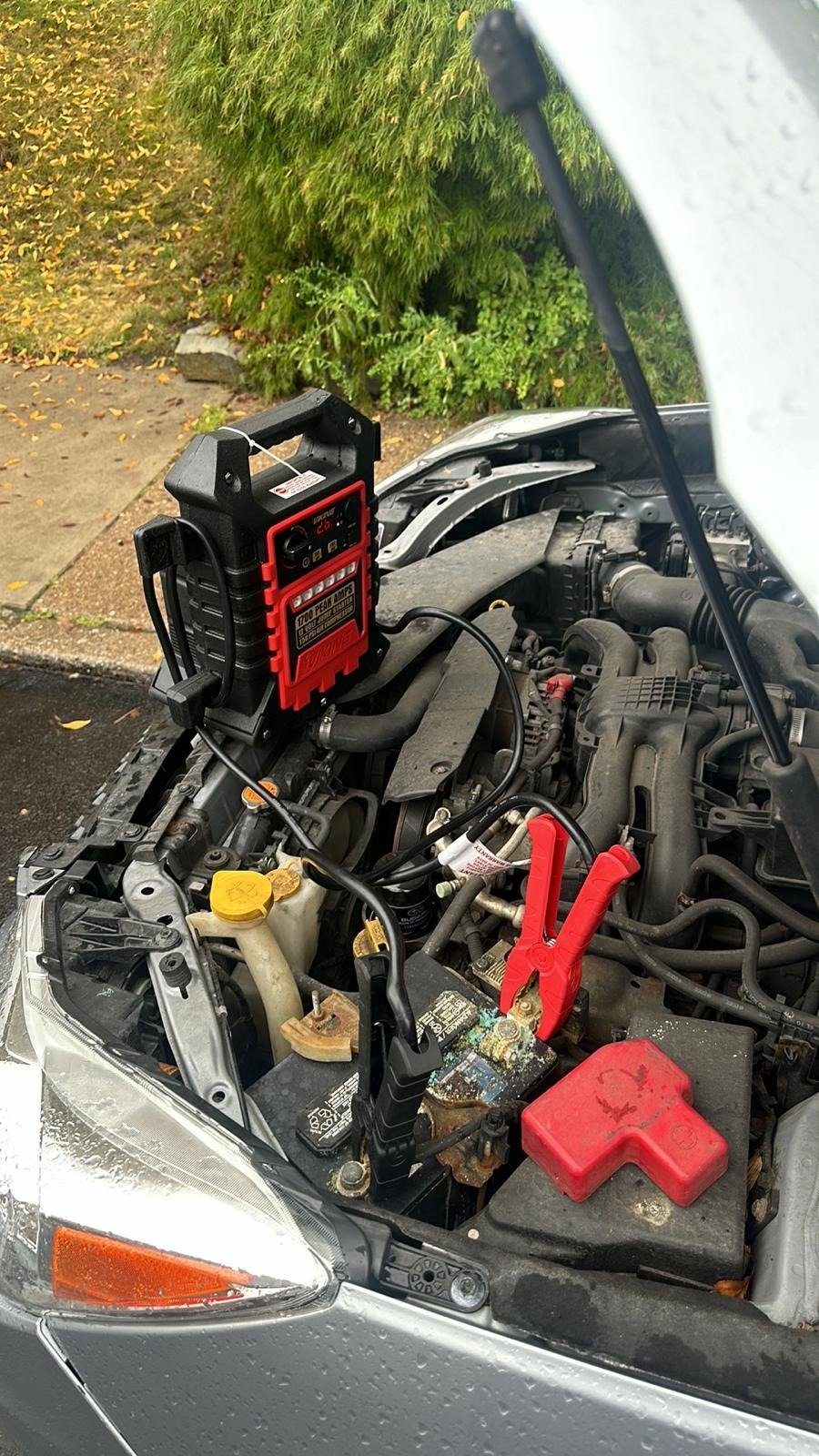
A booster pack is easier in the rain: no second car to line up and fewer cables on wet ground. Our technicians start with a booster pack and switch to heavy jumper cables from the service truck when the pack does not have enough power. A pack also means no neighbour in the drizzle holding your umbrella. How to use one is in how to use a jump starter.
When to call instead
- You are on a shoulder in heavy rain or poor visibility.
- There is thunder or lightning nearby.
- The battery is cracked, leaking, swollen or frozen.
- The car clicks or dies again after a jump. See why a car will not jump start.
In Columbus, a jump start from Roadmate is an estimated $75 to $150. After the jump we test the battery, the alternator and the charging system, and we jump the 12-volt battery on hybrids and EVs on site. We arrive in about 32 minutes on average, depending on traffic, weather and location, 6 AM to 8 PM daily.
If it rained and the car started fine with your own cables, you did not need us. That is a good day.
Frequently asked questions
Can you jump cars in the rain?
Yes. A car's 12-volt system cannot push a dangerous current through wet skin. Dry the clamps and terminals, keep the clamps apart, and do not jump during a thunderstorm.
Can you get electrocuted jumping a car?
Not from a normal 12-volt car battery. The real risks are sparks igniting battery gas, and burns if a clamp, wrench or ring shorts across the terminals.
Is it safe to use a jump starter in the rain?
Yes, with the same care as cables. Keep the pack out of puddles, under the open hood, and check its manual for any weather limits.
Can you jump a car in the snow?
Yes. Clear the snow around the battery and dry the terminals first. A cold battery may need longer to take the jump, so have it tested afterwards.
Can you jump a frozen battery?
No. Carmakers warn that a frozen battery can rupture or explode when jumped. If the case bulges or you can see ice, leave it and call for help.
What should you not do when jumping a car?
Do not let the clamps touch, lean over the battery or smoke near it. Do not jump a cracked, leaking or frozen battery, and do not stand between two cars on a road shoulder.
The bottom line
You can jump a car in the rain, and a 12-volt system will not shock you. Dry and separate the clamps, ground the last one away from the battery, and park clear of traffic. Wait out lightning in the car, and never jump a frozen or swollen battery.
Dead battery in the rain?
Call (380) 288-2822, 6 AM to 8 PM daily, Eastern Time. A dispatcher confirms the price and an arrival estimate before anyone heads your way.
May your next rainy morning sound like wipers and an engine, not a click.