Car Start Jump: What to Do When Your Battery Dies
Aug 12, 2026 · 9 min read
If you are wondering what to do when your car battery is dead, a safe jump usually gets you moving again. This guide covers how to jump start a car, the right jumper cable order, when to use a portable jump starter, the safety steps that matter, and how long to run the engine afterward so you do not end up stranded twice.
One exception first: if the battery is swollen, leaking, or smells like rotten eggs, do not jump it. Replace it.
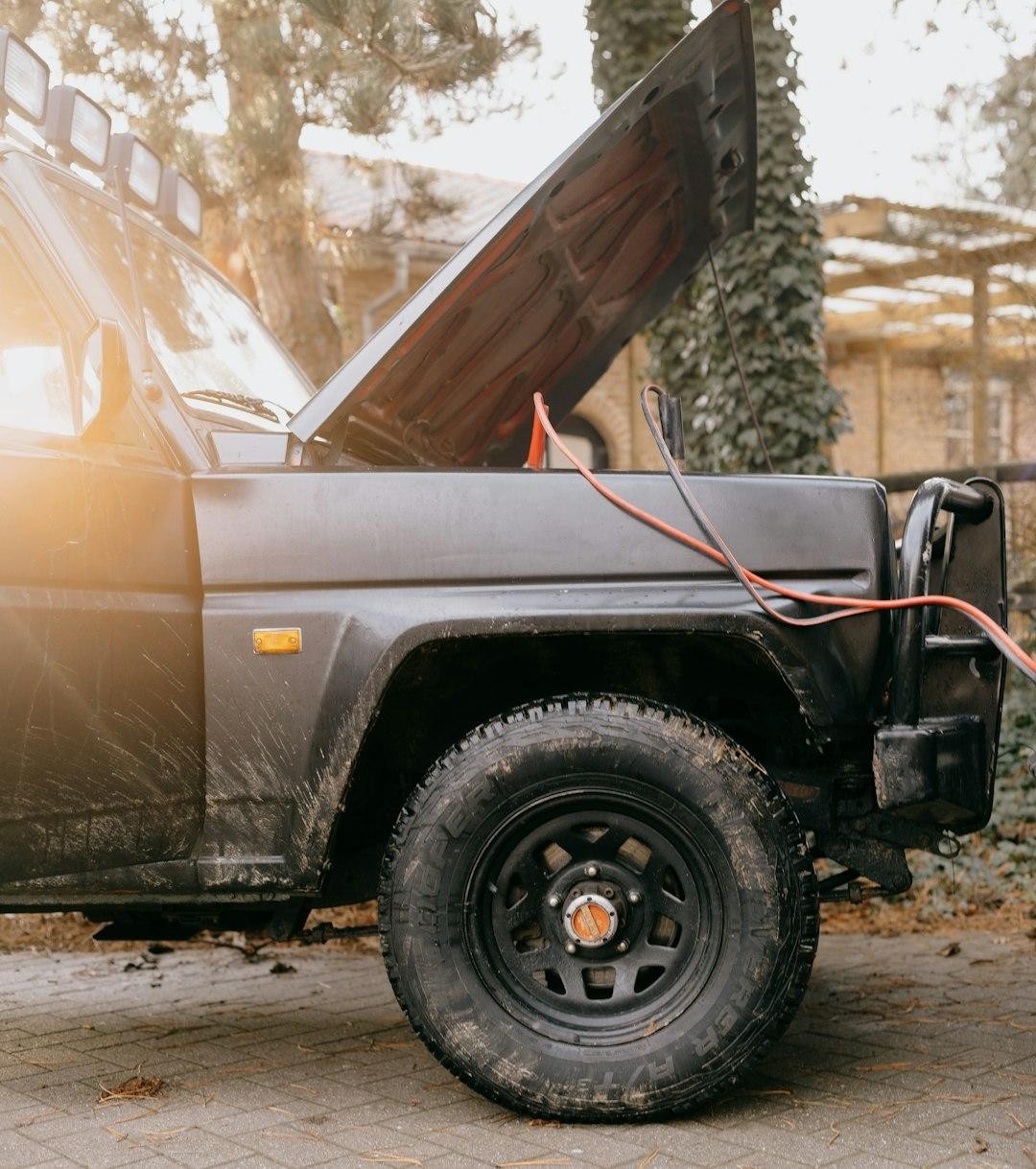
Dead battery? Start with these checks
Before you try a jump, make sure the battery is actually the problem.
- Rapid clicking, dim lights, no crank, or fading accessories usually mean the battery is weak.
- Turn off headlights, AC, radio, and heated seats to cut the load.
- Check for loose battery terminals.
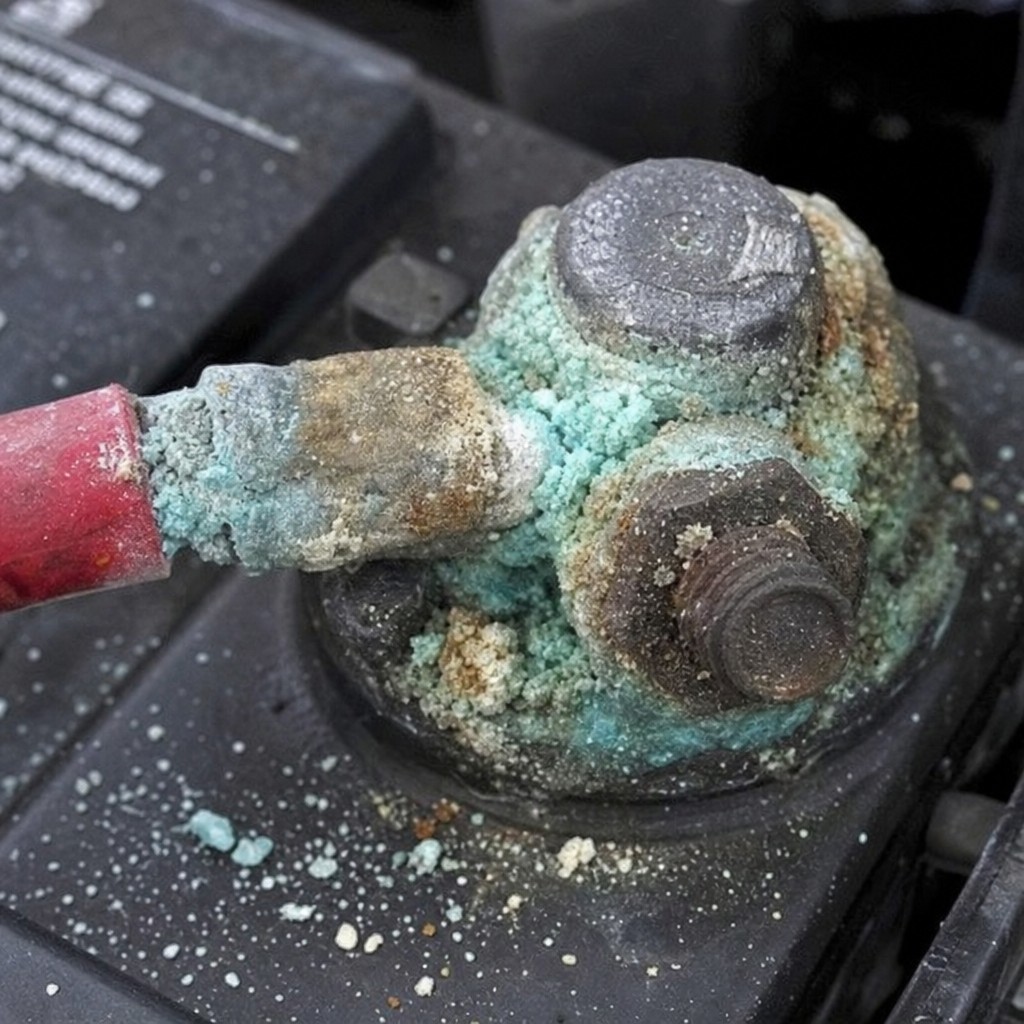
- White or blue crust on the posts means the terminals need cleaning.
- If the battery leaks, smells bad, or looks swollen, do not jump it. Replace it.
Jump start safety precautions
A jumper setup is simple, but batteries vent explosive gas. Follow these every time:
- Wear eye protection and do not lean over the battery.
- Keep sparks and flames away. Do not smoke.
- Put both vehicles in Park, or Neutral for a manual, and set the parking brakes.
- Turn the ignitions off and remove metal jewelry.
- Use cables with intact insulation and never let the clamps touch each other.
- Confirm the voltage matches. Most passenger cars are 12V.
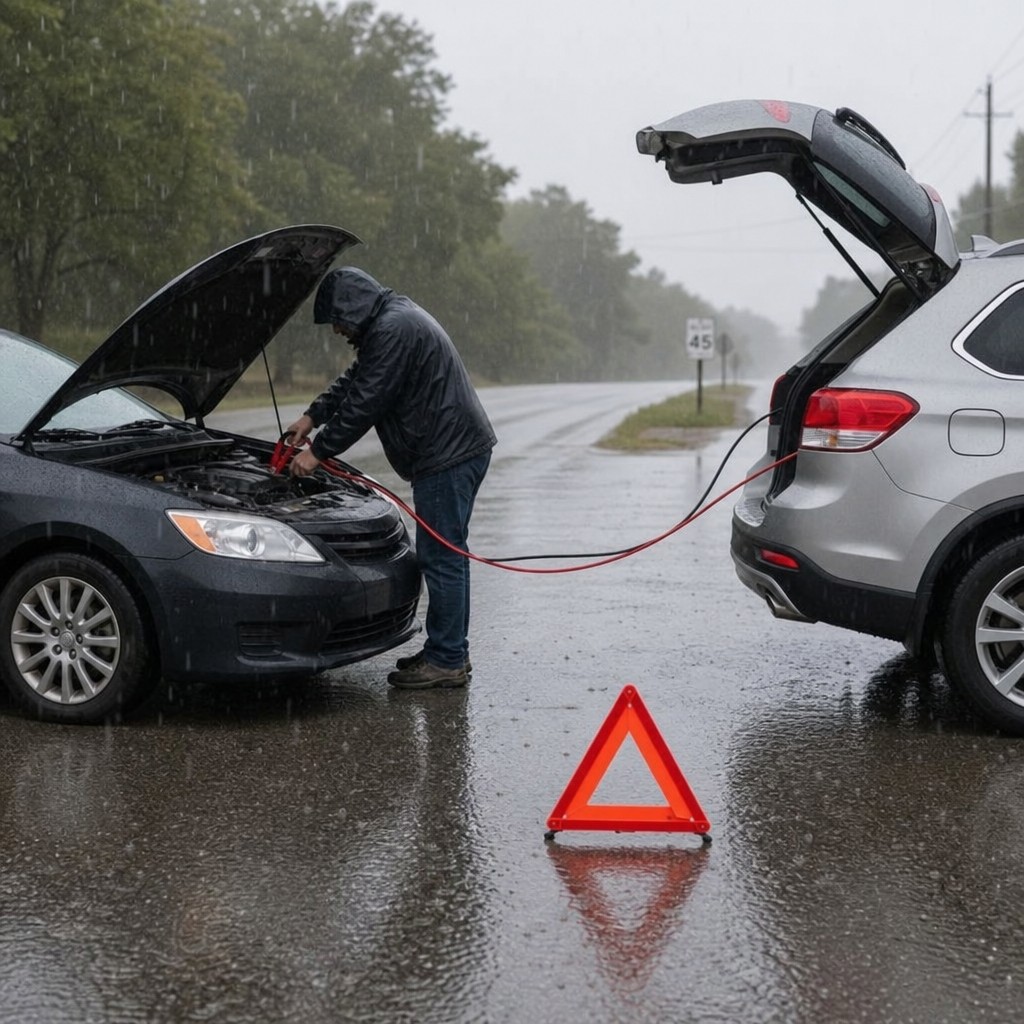
Can you jump start in the rain?
Yes, usually. Keep the clamps out of puddles, avoid standing water, connect only to the correct posts or a proper ground, and skip it if the wiring is damaged or the battery case is cracked.
What causes a car battery to die?
- Lights left on or a door not fully closed
- Cold weather that lowers available power
- Short trips that never fully recharge the battery
- Age. Most batteries last 3 to 5 years
- Corrosion or loose terminals
- Parasitic draw from accessories or a bad module
- Charging system trouble such as the alternator or belt
If the car dies again soon after a jump, get the battery and charging system tested instead of jumping it again.
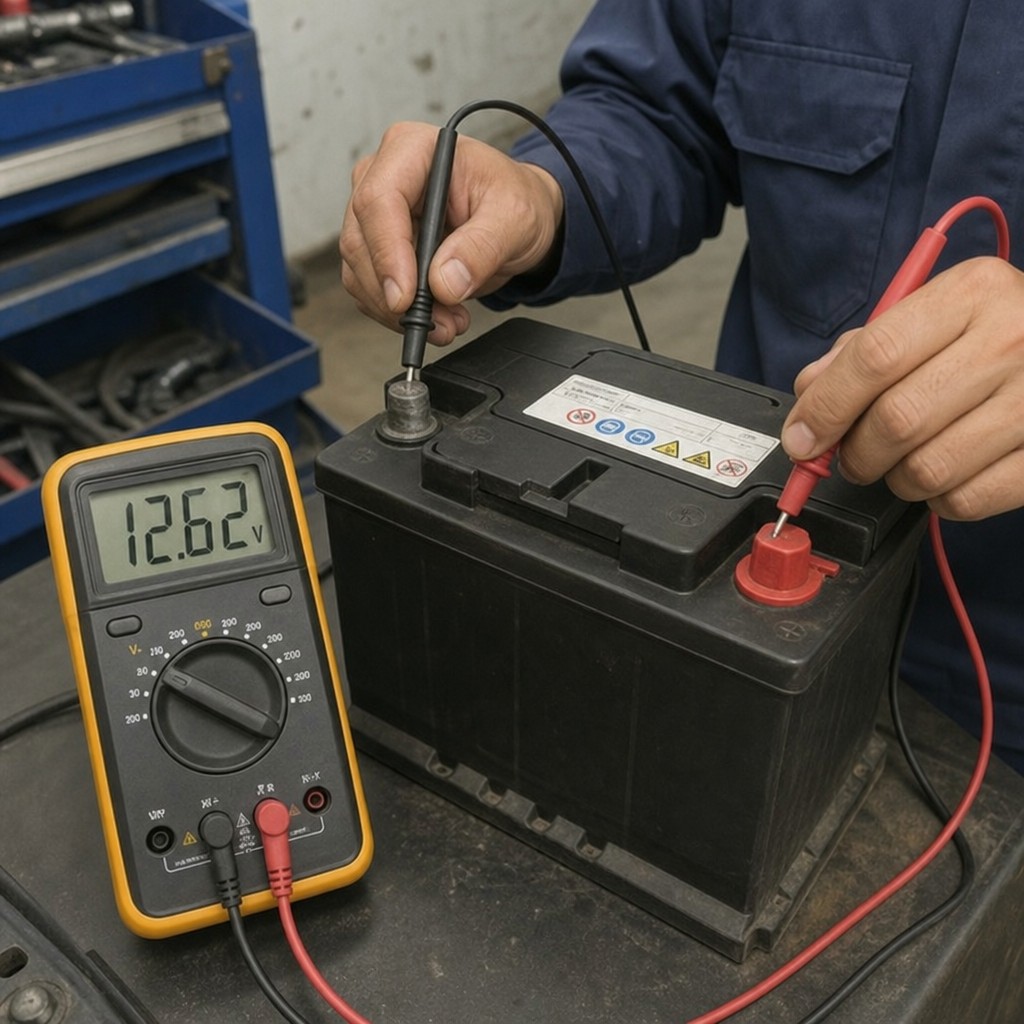
How to jump start a car with jumper cables
You need a decent set of jumper cables, a donor vehicle with a healthy battery, and a safe spot away from traffic.
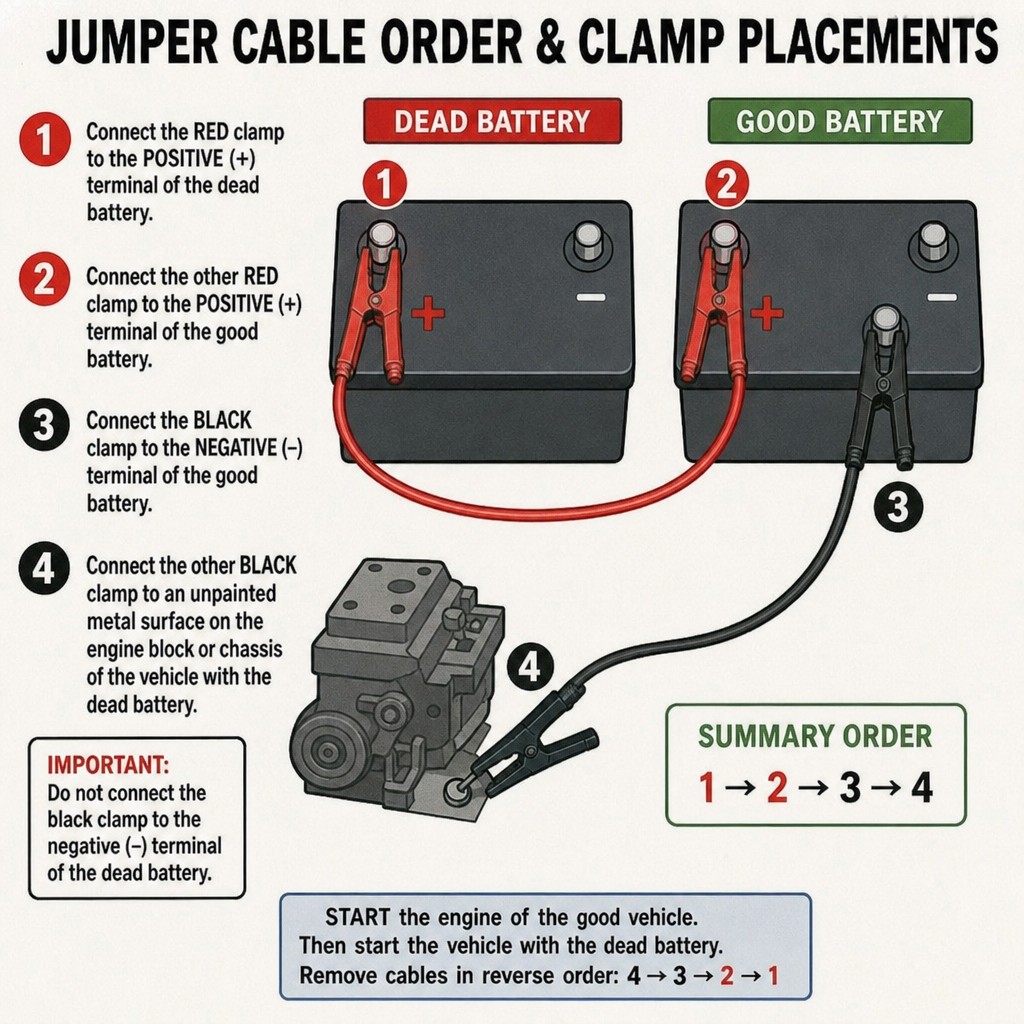
Jumper cable order
The order matters because it lowers the chance of a spark near the dead battery.
- Red clamp to the dead battery positive.
- Red clamp to the good battery positive.
- Black clamp to the good battery negative.
- Black clamp to clean, unpainted metal on the dead car, away from the battery.
Do not connect the last black clamp to the negative terminal of the dead battery.
Starting the car
- Start the donor vehicle and let it run 2 to 3 minutes.
- Try the dead car. If it does not start within 5 to 8 seconds, stop and wait a minute.
- Once it starts, let both cars run for a minute.
If it still will not start, you may be looking at a starter issue, a seized engine, a bad cable contact, or a battery that is finished.
Removing the cables
- Black clamp from the ground on the revived car
- Black clamp from the donor battery
- Red clamp from the donor battery
- Red clamp from the revived car
Do not let the clamps touch body panels or each other.
Automatic vs manual transmission
The cable method is the same, the setup changes slightly. On an automatic, put it in Park, set the brake, and do not rev hard. On a manual, put it in Neutral, set the brake, keep the clutch down while cranking if needed, and make sure no gear is engaged. Push-starting is a different thing and is not safe or even possible on many modern cars.
Jump starter vs jumper cables
Cables are cheap, simple, need no charging, and work great when another car is nearby. The downside is you need that helper vehicle, and a poor connection can cause damage.
A portable jump starter lets you do it without another car. It is self-sufficient, handy in an empty lot, and often adds lights, USB power, and safety features. The trade-off is you have to keep it charged, and budget units can struggle in cold weather.
What to look for in a booster pack
- Reverse polarity protection and spark-proof clamps
- Over-current and over-voltage protection
- Clear battery status lights
- Enough cranking power for your engine
- Strong clamps and thick cables
- USB-C or USB ports if you want them
- A good operating temperature range
Focus on build quality and protections rather than the biggest peak-amp number on the box.
How to use a portable jump starter
- Turn the car off and open the hood.
- Connect red to positive and black to negative, or to an approved ground if the manual says so.
- Turn the pack on or switch to boost mode.
- Start the car with a brief crank.
- Turn the pack off and remove the clamps.
If the battery is very low, some packs need a special override mode before they will deliver power.
Does jumper cable gauge matter?
Yes. A lower gauge number means thicker cable and better power transfer. For most cars, 4 to 6 gauge is a solid all-around choice. For larger engines or cold climates, 2 gauge is better. Very thin emergency cables can overheat and often will not turn over a big engine.
Cleaning corroded terminals
- Turn the car off, wear gloves and eye protection.
- If you have tools, disconnect negative first, then positive.
- Use a battery brush or a baking soda and water paste.
- Rinse carefully and dry the area.
- Reconnect positive first, then negative, and tighten snugly.
Roadside with no tools, you can sometimes get better contact by clamping to clean metal or gently wiggling the clamps, but only with both cars off.
After the jump
Let the engine idle 10 to 15 minutes if you are waiting for help, or better, drive 20 to 30 minutes at normal speed to actually recharge. Do not shut the car off right away. If it dies again soon after, the battery is weak or the alternator is not charging.
If the car still will not start
- Wrong clamp placement
- Poor ground connection
- Corrosion blocking contact
- A weak donor battery
- An internally failed battery
- A starter or alternator problem
The takeaway
A safe jump is mostly prep and sequence: connect in the right order, follow the safety steps, and consider a battery pack if you often park where no help is around. Once it runs, give the charging system real time to recover. If the problem keeps coming back, find out why the battery is draining instead of relying on repeat boosts.
Frequently asked questions
How do I know it is really the battery and not something else?
Look for classic weak-battery signs: rapid clicking, dim lights, no crank, or fading accessories. Check the terminals for looseness or corrosion, turn off all accessories and try again. If the battery smells like rotten eggs, leaks, or looks swollen, do not jump it, replace it. If jump attempts keep failing, think about the starter, the engine, or a charging-system problem.
What is the correct jumper cable connection and removal order?
Connect in this order: red to dead battery positive, red to good battery positive, black to good battery negative, black to an unpainted metal ground on the dead car. Start the donor, wait a couple of minutes, then start the dead car. Remove in reverse: black from ground, black from donor battery, red from donor battery, red from the revived car.
Is it safe to jump start in the rain?
Yes, if you keep clamps and connections out of puddles, avoid standing water, connect only to proper posts or approved grounds, and do not use damaged wiring or a cracked battery. Keep the usual safety steps: eye protection, no sparks or flames, both vehicles in Park or Neutral with parking brakes set.
How long should I let the car run after a successful jump?
Let it idle 10 to 15 minutes if you are parked, but ideally drive 20 to 30 minutes at normal speed to recharge. If it stalls again soon, the battery may be failing or the alternator may not be charging. Get both tested.
Should I carry jumper cables or a portable jump starter?
Cables are cheap and work well when another vehicle is nearby, but you need a helper. A portable jump starter makes you self-sufficient and often adds lights, USB power and safety protections, but it must be kept charged and cheap units can struggle in the cold.
Gear that makes the next jump a two minute job
A charged jump pack in the trunk means you never have to flag down a stranger at midnight.
Heads up: the links below go to Amazon and Roadmate earns a small commission if you buy something. Costs you nothing extra and it helps keep the dispatch line running.
NOCO Boost GB40 Jump Starter (1000 Amp)
1000-amp lithium jump pack for gas engines up to 6L and diesels up to 3L. Spark-proof clamps, USB power bank, built-in LED flashlight. The one our techs actually carry.
View on AmazonHeavy-Duty Jumper Cables (20 ft, 4-gauge)
If you'd rather use a donor car, get real cables. Thin cables from the gas station rarely deliver enough current.
View on Amazon
Need a jump right now?
We can dispatch a jump start or a battery swap in minutes.
Related reading: what to do when your car battery dies and how much a new car battery costs.