4 Gauge Jumper Cables: What Gauge Do You Need?
Published Oct 23, 2026 · 5 min read · By Hassan, Owner of Roadmate Services
Every set of jumper cables looks tough in the store. A January morning is what sorts them out. For most cars, 4 gauge jumper cables about 16 to 20 feet long are the right choice. The lower the gauge number, the thicker the wire. Pickups, big V8s and diesels need 2 gauge or heavier.
Below: a gauge chart by vehicle, what the number means, how long the cables should be, which clamps to look for, and when cables are not the answer at all.
Quick answer: jumper cable gauge by vehicle
Market guidance from published sources, not a Roadmate rule. Your owner’s manual wins.
| Vehicle | Gauge | Length |
|---|---|---|
| Compact and mid-size cars | 4 gauge (6 gauge at the minimum) | 16 to 20 ft |
| Full-size cars, SUVs, V6 and V8 engines | 4 or 2 gauge | 20 ft |
| Pickups and diesels | 2, 1 or 0 gauge | 20 to 25 ft |
| Motorcycles, ATVs, small engines | 8 or 10 gauge | About 12 ft |
| One set for most households | 4 gauge | 16 to 20 ft |
Sources: Mechanic Base and Modern Survival Blog. Checked October 2026.
What jumper cable gauge means
Gauge is the thickness of the copper wire inside, measured on the American Wire Gauge (AWG) scale. The number runs backwards: 10 gauge is thin, 4 gauge is thick, 0 gauge is very thick. It is one of the few scores where lower wins, like golf.
Thicker wire carries more current with less heat and less voltage lost on the way. That matters most in the cold. A cold engine is harder to turn, and a cold battery has less to give. NHTSA notes that battery power drops with the temperature and lists jumper cables among the things to carry in winter.
4 gauge vs 6 gauge jumper cables
Pick 4 gauge if you can. Published maker figures, averaged by Modern Survival Blog, put 4 gauge cables at about 300 to 500 amps and 6 gauge at about 200 amps, which that source calls borderline for cars.
A 6 gauge set will start a small car with a battery that is only low, on a mild day. Most of our jump calls in Columbus come on cold mornings, and that is when a thin set runs out of margin. A thicker cable is one of the few winter purchases where more really is better.
2 gauge and 0 gauge jumper cables: when you need heavy gauge
Large SUVs, full-size pickups and V8s do better with 2 gauge. Diesels draw the most current to start, and the same source puts them at around 800 to 1,000 amps, so 1 gauge or 0 gauge (also sold as 1/0) is the safer choice.
Some diesel trucks carry two batteries. Check the jump-start section of the owner’s manual for where to connect, and do the same on start-stop cars and hybrids, which often have dedicated jump points. Heavy gauge sets are stiff and weigh more; carrying one back to the truck counts as part of your workout.
8 gauge and 10 gauge jumper cables: what they are good for
Motorcycles, ATVs, lawn tractors and other small engines. For a car with a fully dead battery, 8 and 10 gauge cables are often too thin, and they get warm while the engine still only clicks.
They are usually the cheapest set on the shelf, which is exactly why so many cars carry them. Think of them as the gas-station umbrella of car gear: fine until the weather turns serious.
How long should jumper cables be, and which clamps to look for
- 12 feet: easy to store, but the cars must park nose to nose.
- 16 to 20 feet: the best all-round length. It reaches when the other car is beside you or behind you in a tight lot.
- 25 feet: trucks, trailers and awkward parking.
Mechanic Base recommends solid copper clamps over copper-plated steel, because the plating wears off and the steel underneath conducts worse. Look for strong springs that bite onto the terminal, and insulation that stays flexible in the cold instead of cracking. Short cables have a way of turning a simple jump into a parking puzzle.
Once you have good cables, the connection order is in our guide to jumping a car safely. Keep them with the rest of your emergency car kit.
Jumper cables or a booster pack?
Cables need a second car with a healthy battery, parked close enough. A portable booster pack needs only you. That is the main difference, and it is why our technicians start with a booster pack on a jump call. When a battery is too far gone for the pack, they switch to heavy jumper cables from the service truck.
One example: a van driver was dropping off a delivery at a Kroger in Columbus, came back, and the van would not start. We arrived in about 30 minutes and the jump took under 2 minutes. The battery tested fine afterwards; the lights had been left on. No second car, no cables to untangle. If you want a pack of your own, start with how to use a jump starter.
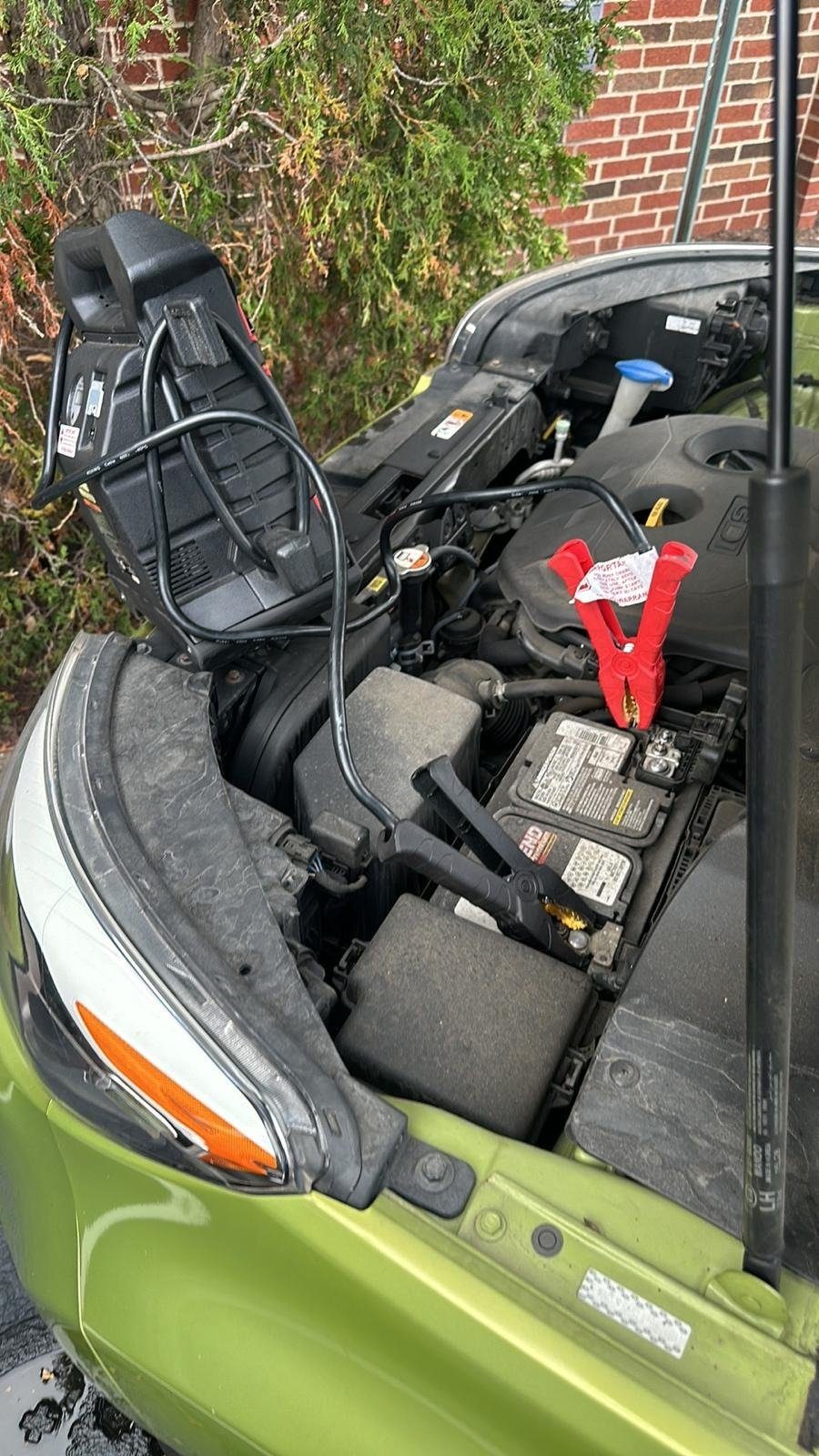
Cables still earn their spot in the trunk. They just need a friend with a running car.
When jumper cables will not fix it
Good cables fix a flat battery. They do not fix a bad starter, a battery that will not hold a charge, or an alternator that has stopped charging. If thick cables are on tight and the car still only clicks, or it dies again soon after, see why a car will not jump start and what the clicking means.
If you are stopped on a highway shoulder, do not stand between two cars in traffic with cables. Get safe, then call.
In Columbus, a jump start from Roadmate is an estimated $75 to $150. After the jump we test the battery, the alternator and the charging system. A failed starter is not a roadside fix; that car gets a tow to a shop. We arrive in about 32 minutes on average, depending on traffic, weather and location, 6 AM to 8 PM daily.
Frequently asked questions
What gauge jumper cables do I need for my car?
For most cars, 4 gauge jumper cables about 16 to 20 feet long. Large SUVs, pickups and diesels need 2 gauge or thicker, because their engines draw more current to start.
Is 4 or 6 gauge better for jumper cables?
4 gauge is better. The wire is thicker, so it carries more current with less heat and less voltage lost along the way. 6 gauge can start a small car in mild weather, but it is a minimum, not a margin.
Are 8 gauge jumper cables good enough?
For a motorcycle, an ATV or a lawn tractor, yes. For a car with a fully dead battery, 8 and 10 gauge cables are often too thin, especially on a cold morning. They may work if the battery is only a little low.
What does a lower gauge number mean?
A thicker wire. Gauge follows the American Wire Gauge scale, where the number goes down as the copper gets thicker. So 2 gauge is heavier than 4, and 0 gauge is heavier still.
How long should jumper cables be?
16 to 20 feet covers most jumps, including when the cars cannot park nose to nose. 12-foot sets store easily but need the cars very close. 25 feet helps with trucks and awkward parking.
Do I need heavy gauge jumper cables for a truck?
Yes. Pickups, large SUVs and diesels need 2 gauge or thicker, and many diesel owners use 1 or 0 gauge. Some diesels have two batteries, so check the owner's manual for where to connect.
The bottom line
Buy 4 gauge jumper cables, 16 to 20 feet long, with solid copper clamps, and you are covered for most cars. Go to 2 gauge for big SUVs and pickups, and 1 or 0 gauge for diesels. Leave 8 and 10 gauge for small engines. If good cables do not start the car, the battery is not the only suspect.
No cables, or no second car?
Call (380) 288-2822, 6 AM to 8 PM daily, Eastern Time. A dispatcher confirms the price and an arrival estimate before anyone heads your way.
Here is to jumper cables that live a long, boring life in the bottom of your trunk.