Bubble in Your Tire? What It Means and What to Do Now
Published Oct 23, 2026 · 5 min read · By Hassan, Owner of Roadmate Services
A bubble in a tire is a bulge where the cords inside the tire have broken and air is pushing on the outer rubber. It cannot be repaired. Do not drive far or fast on it: put the spare on or replace the tire.
The outer rubber is now holding the air on its own, a job it never applied for.
Quick answer: tire bubble, indent or normal?
| What you see | What it means | What to do |
|---|---|---|
| Round bulge on the sidewall | Internal damage: broken cords | Stop driving on it. Fit the spare or replace the tire |
| Bulge on the tread | The steel belts are separating | Same. Do not drive at speed |
| Shallow dip or line in the sidewall | Usually a normal indent | Have it checked if you are unsure |
| Bulge plus vibration or thumping | The damage is getting worse | Pull over somewhere safe and call |
What does a bubble in a tire mean?
A tire has an airtight inner liner, layers of fabric cords, and rubber on the outside. A hard hit can snap some of those cords. Air then leaks through the gap and pushes the outer rubber out into a bubble.
The sidewall has no steel belts behind it, which is why most bulges show up there. A bubble is the tire telling you, quietly, that it has had enough.
What causes a tire bubble?
- Impact: potholes, curbs, speed bumps and debris. The most common cause, and a Columbus winter leaves plenty of potholes.
- Low pressure: a soft tire gets pinched harder against the rim.
- Overloading: extra weight strains the sidewall.
- A defect: rare. If a newer tire bulges with no hit you remember, check the warranty.
Some potholes have been on the same street longer than some of the houses, and they still win.
Can you drive on a tire with a bubble?
No, beyond a slow trip to a safe place. A bulged tire can blow out without warning, and heat and speed make that more likely.
If you spot a bubble on the highway, get safe, then call. Take the next exit if you can. If you have to stop on the shoulder, pull as far right as you can, turn on your hazards and stay buckled in. Do not change a tire on the traffic side of a highway shoulder. Our guide to driving on a flat tire covers what to do if the tire goes flat on the way.
Can you fix a tire bulge?
No. A plug or patch seals a hole in the tread; it does not rebuild broken cords. The U.S. Tire Manufacturers Association limits repairs to the tread area and says damage reaching the shoulder or sidewall takes the tire out of service. A bulge is a new-tire job, and we will tell you so rather than sell you a repair.
See also what can and can’t be repaired on a punctured tire. A patch on a bulge is a bandage on a balloon.
Bulging tire vs sidewall indent
A shallow dip or line running across the sidewall is usually an indent. It comes from where the cord layers overlap during building and is normal: the tire’s dimples, harmless. A bulge sticks out. An indent sinks in.
With the car parked, run a hand over the sidewall. Anything that rises above the surface is a bubble. Not sure? Have a tire shop look before your next long drive.
How to prevent tire bubbles
- Check tire pressure once a month, as NHTSA recommends, and before long trips. Pressure drops in the cold; see tire pressure in cold weather.
- Slow down for potholes you can see.
- Park away from curbs instead of rubbing them. The curb does not care about your rims.
- Look at your tires when you fill up. A walk-around catches a bulge early.
As Hassan puts it: “You can’t predict a flat tire or plan for it. You can avoid some of them by having good tires on the car, not bald ones. But it always happens at the wrong time.”
Found a tire bubble in Columbus?
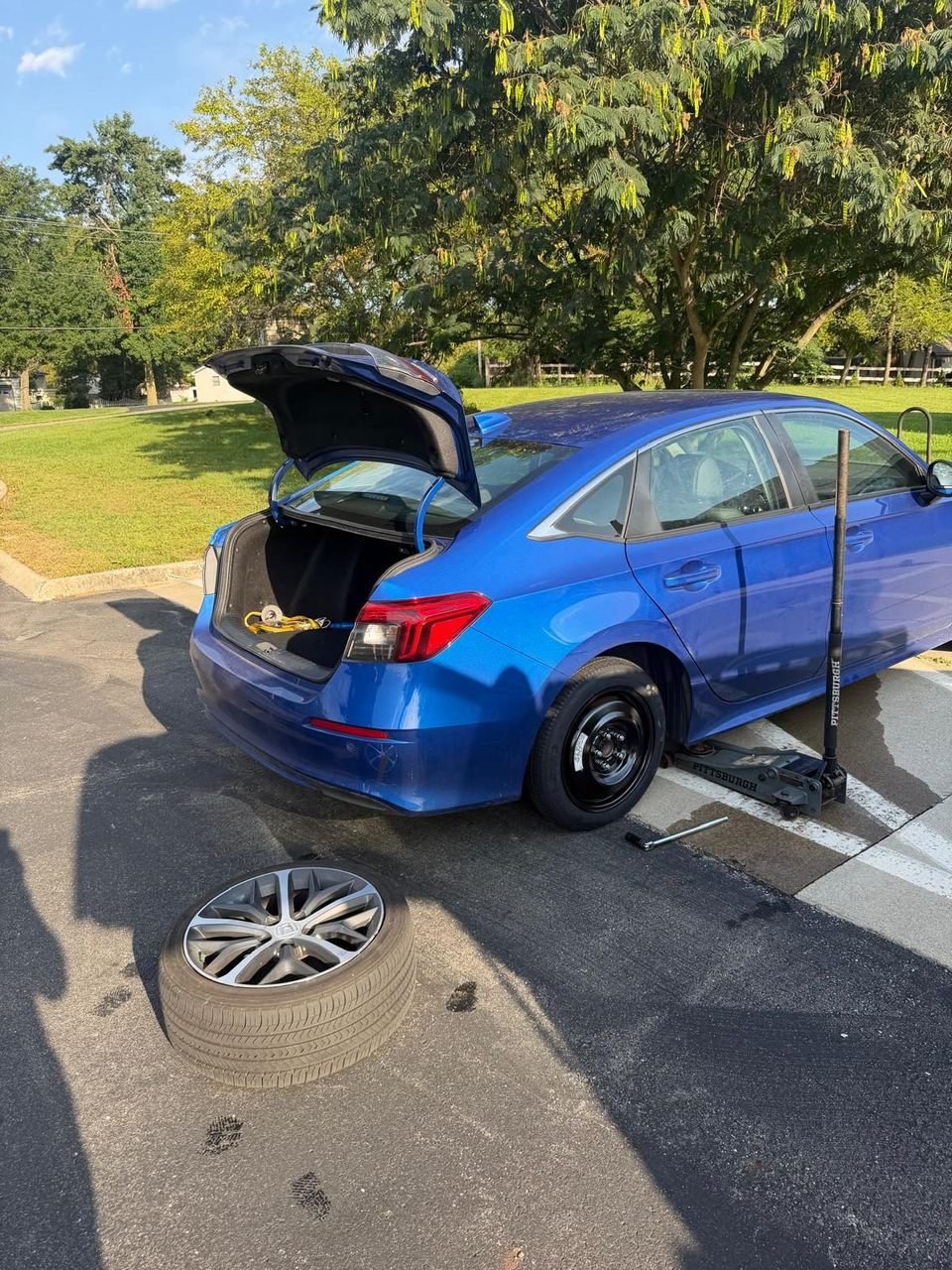
If you have a usable spare, we come to you and fit it. Our estimated Columbus range for a tire change is $85 to $175. A flat spare gets our air compressor.
No usable spare? Many new cars do not have one. We take the damaged tire to a shop, get it replaced, bring it back and fit it, quoted by phone.
We work 6 AM to 8 PM daily and arrive in about 32 minutes on average, depending on traffic, weather and location. Doing it yourself? Here is how to change a flat tire safely.
Frequently asked questions
Can you drive on a tire with a bubble?
Only slowly, and only as far as a safe place to stop or fit the spare. A bulged tire can fail without warning, especially at highway speed or in heat.
Can you fix a tire that has a bubble in it?
No. No plug or patch rebuilds broken cords, and industry guidance limits repairs to the tread area, so a bulge means a new tire.
What does it mean if you get a bubble in your tire?
The inside of the tire was damaged, usually by a hard hit from a pothole or curb, and air has pushed through to the outer rubber. That rubber was not built to hold the pressure alone, so the blowout risk stays high.
Does a tire bubble mean I need two new tires?
Not always. If the other tire on the same axle is fairly new, one is often enough; if it is well worn, a shop may suggest a pair. Ask the shop to check both.
Will the warranty cover a tire bubble?
Sometimes. A manufacturing defect may be covered by the tire maker's warranty. Pothole or curb damage counts as road hazard, covered only if your tires came with a road-hazard plan, so check your purchase paperwork.
The bottom line
A bubble in a tire means the inside is broken, and no repair fixes it. Drive only as far as a safe place, then fit the spare or replace the tire. Keep the pressure right and go easy on potholes and curbs.
Tire bubble and nowhere to go?
Call (380) 288-2822, 6 AM to 8 PM daily, Eastern Time. A dispatcher confirms the price and an arrival estimate before anyone heads your way.
May your tires stay round, quiet and wonderfully boring.