How Often to Change Brake Pads (and How Thick They Should Be)
Published Oct 23, 2026 · 5 min read · By Hassan, Owner of Roadmate Services
Brake pads are the one part of your car that does its job by slowly wearing itself away. So how often should you change brake pads? Most last somewhere between 20,000 and 70,000 miles, but the miles are only a rough guide. Pad thickness decides: plan a change at about 1/4 inch, and replace them by the time 3 to 4 mm is left.
Quick answer at a glance
Published figures from named sources.
| Question | Short answer | Source |
|---|---|---|
| How long pads usually last | 20,000 to 70,000 miles | NAPA |
| New pad lining | About 12 mm | Family Handyman |
| Start planning a pad change | About 1/4 inch (roughly 6 mm) | NAPA |
| Replace the pads | 3 to 4 mm left | Family Handyman |
| How often to have brakes inspected | At least once a year | Car Care Council |
| Bottom line | Thickness and warning signs decide, not the odometer | |
Sources: NAPA Know How, Family Handyman, Car Care Council. Checked October 2026.
How often to change brake pads: why the miles vary so much
NAPA gives 20,000 to 70,000 miles and Les Schwab gives 30,000 to 70,000. The window is wide because, as the Car Care Council notes, wear depends on driving habits, road conditions, vehicle type and pad quality.
- Stop-and-go traffic and short city trips wear pads faster than steady highway miles.
- Heavy loads, towing and hilly routes make the brakes work harder.
- Late, hard braking uses up pad material quicker than easing off early.
- Front pads usually go first. When you brake, the weight shifts forward, so the front brakes do most of the work.
A commute that is mostly brake lights on I-270 at 5 PM counts as overtime for your pads, and they do not get paid extra for it.
Brake pad thickness: when is it time?
A new pad has about 12 mm of friction material. Sources draw the line in slightly different places: NAPA says replace pads below 1/4 inch (about 6 mm), and Family Handyman puts the replacement point at 3 to 4 mm. The simple way to read both: 1/4 inch means book it, 3 to 4 mm means do it now.
| Pad material left | What it means | What to do |
|---|---|---|
| About 12 mm | New pad | Nothing to do |
| 6 to 12 mm | Plenty left | Check again at the next inspection |
| About 6 mm (1/4 inch) | Wearing down | Plan the pad change |
| 3 to 4 mm | Worn | Replace the pads soon |
| Under 3 mm | Wear indicator may squeal | Replace now |
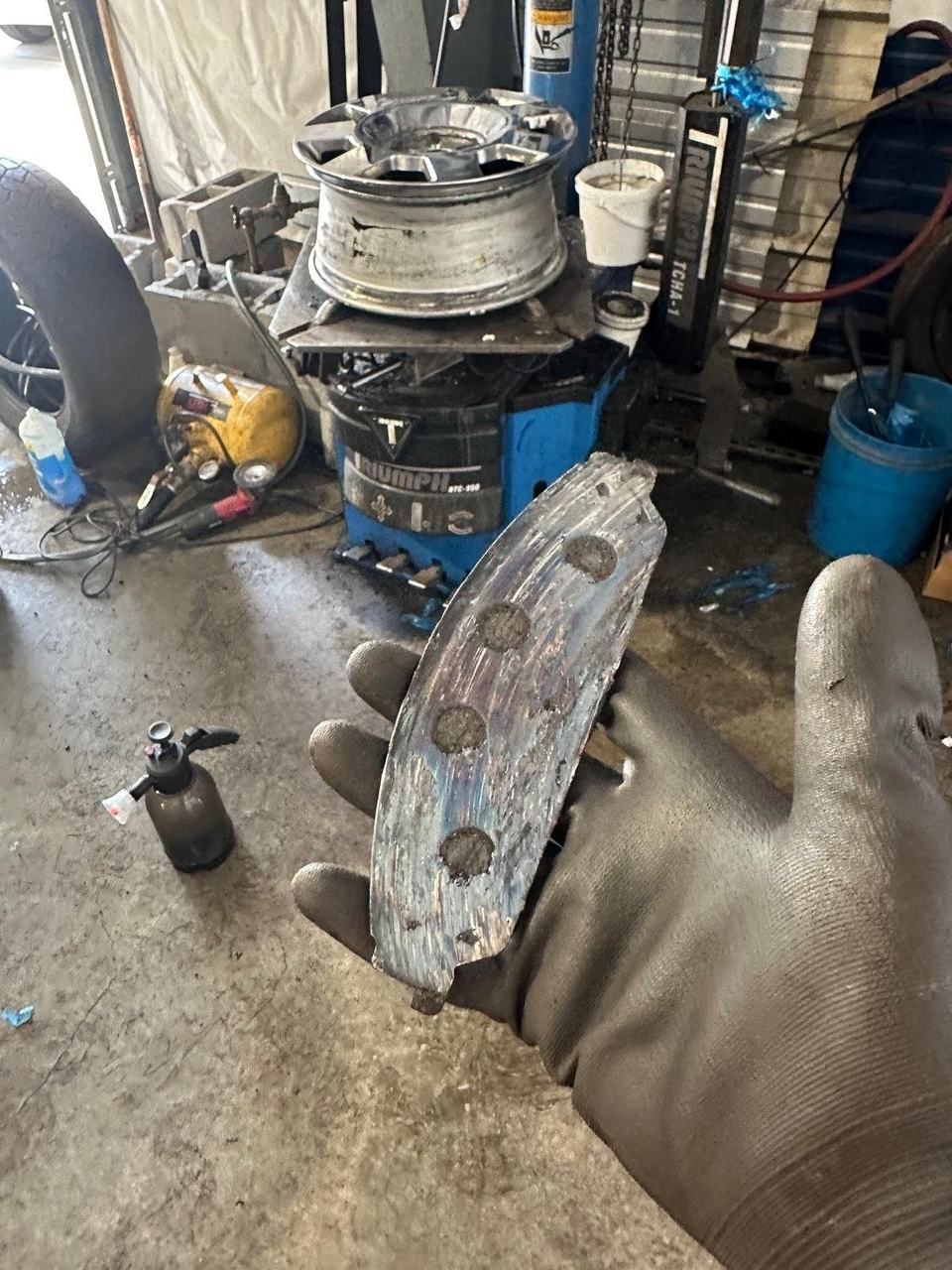
| Metal on metal | Pad material gone | Stop driving and get a tow |
Based on NAPA and Family Handyman. Your manufacturer’s minimum may differ.
When to change brake pads: the warning signs
- A high squeal when you brake. Many pads have a small metal tab that touches the rotor at about 3 mm left. It is the pad clearing its throat to get your attention.
- A pad wear light on the dash. Some cars have electronic wear sensors that turn on a warning when the pads are low.
- Longer stops. The car needs more distance to slow down.
- Vibration or pulling. A shaking pedal or a car that pulls to one side under braking needs a brake check soon.
Signs that mean stop driving
Do not keep driving if you notice any of these
- The brake pedal feels soft or sinks, or goes to the floor.
- Brake fluid is leaking under the car.
- The red brake warning light is on and the pedal feels soft.
- Grinding metal on metal when you brake.
Pull over safely and get a tow to a shop instead of driving there. On a highway, get safe first, then call: move off the roadway if you can, or stay buckled in with your hazards on. Our highway breakdown guide has the full steps, and towing in Columbus gets the car to a mechanic.
These point to a brake system fault, not just worn pads. A soft pedal needs a shop, not a pad swap, and we will tell you so.
How to check your brake pads yourself
- Park on level ground and let the brakes cool. Rotors get hot after a drive.
- Look through the spokes of a front wheel with a flashlight and find the caliper clamped over the rotor.
- Compare the pad material to the metal backing plate behind it. If the pad looks thinner than about 1/4 inch, plan a change.
Easiest timing: a tire rotation, when the wheels are already off. Our post on how often to rotate tires covers that schedule. Crouching in a parking lot staring at your wheels finally counts as productive.
Frequently asked questions
How many miles do brake pads usually last?
Published ranges run from about 20,000 to 70,000 miles, according to NAPA, and 30,000 to 70,000 miles, according to Les Schwab. Your owner's manual and a measured thickness are better guides than the odometer.
Is 4 mm of brake pad OK?
It still stops the car, but it is close to the end. Family Handyman puts the replacement point in the 3 to 4 mm range, so at 4 mm it is time to book the pad change rather than wait for the squeal.
How often should brakes be inspected?
The Car Care Council recommends a brake inspection at least once a year. Les Schwab suggests a look every 5,000 miles or six months.
Do I need new rotors every time I change brake pads?
Not always. Rotors are checked for thickness and damage when the pads are changed. If worn pads have been grinding metal on metal, the rotors are usually damaged too and need replacing along with the pads.
More brake guides: brake pad replacement cost; why brakes squeak; grinding noise when braking.
The bottom line
Most brake pads last 20,000 to 70,000 miles, but measure instead of guessing. Plan a change around 1/4 inch, replace by 3 to 4 mm, and have the brakes inspected at least once a year. A soft pedal, a fluid leak or metal grinding means stop driving and get a tow.
Pads getting thin? We come to you in Columbus.
Our technicians replace brake pads and rotors where your car is parked. Brake work is quoted by phone, so you know the price before anyone heads your way. Call (380) 288-2822, 6 AM to 8 PM daily, Eastern Time, or send a quote request.
Here is to stops so quiet you forget the brakes are even there.