Does a Power Inverter Drain Your Car Battery?
Published Monday, October 26, 2026 · Updated October 26, 2026, 5 PM ET · 6 min read · By Hassan, Owner of Roadmate Services
Yes. A power inverter drains your car battery whenever it is switched on and the engine is off, and it can do it overnight even with nothing plugged in. With a real load it is much faster: a 400-watt load can flatten a healthy battery in about an hour. Switch the inverter off, or unplug it, every time you park.
We saw it at 6:30 this morning, Monday, October 26, in an apartment lot in the Hilliard area. A Glass Doctor work van, a Ford Transit, would not start. The power inverter inside had been left on all night.

Power inverter and battery drain at a glance
| Does an inverter drain the battery? | Yes, whenever it is switched on and the engine is off |
| With nothing plugged in? | Yes, slowly. Many inverters draw a little power just waiting for a load |
| How fast with a load? | Fast. A 400-watt load can flatten a healthy battery in about an hour (Schumacher) |
| Engine running? | Much safer. The alternator carries a small inverter |
| Bottom line | Switch it off, or unplug it, every time you switch the engine off |
Why a power inverter drains the battery
An inverter turns the 12-volt power from your battery into household power for laptops, chargers and tools. With the engine running, the alternator refills the battery as you go. With the engine off, every bit of that power comes straight out of the battery, and nothing puts it back.
Even with nothing plugged in, the inverter is not fully asleep. As Four Wheel Ask explains, many inverters draw a small current just waiting for a load, and over a full night that adds up. An inverter left on is a bit like a fridge with the door open: nothing much seems to happen, until the morning.
The same goes for anything else left on overnight: lights, phone chargers in a socket that stays live, a dash cam. Our guide to why a car battery keeps dying covers the other usual suspects.
How fast can an inverter drain a car battery?
It depends on the load. In Schumacher Electric’s guide, a 400-watt inverter at full load pulls about 37 amps once you count its losses. A typical car battery would be completely flat in about 54 minutes at that rate.
Smaller loads last longer, but not all night. Four Wheel Ask suggests keeping engine-off use with small loads to an hour or less, and keeping the battery above about 12.1 to 12.2 volts at rest, so there is still enough to start the engine. A starter battery is built for one big push in the morning, not a night shift.
Cold makes it worse. A battery that was already weak, or a cold Columbus morning, leaves less in reserve. Our battery testing guide shows how to read your battery’s voltage.
From the road: the Glass Doctor van in Hilliard
A woman called us early Monday from the Hilliard area. The work van would not start, and the cause was simple: the power inverter inside had been on all night and drained the battery. We were there in about 40 minutes.
In the apartment lot, we opened the hood and jump-started the Transit with our 1,700-peak-amp jump pack. The van started, and the driver was back on the road. The job was $90.
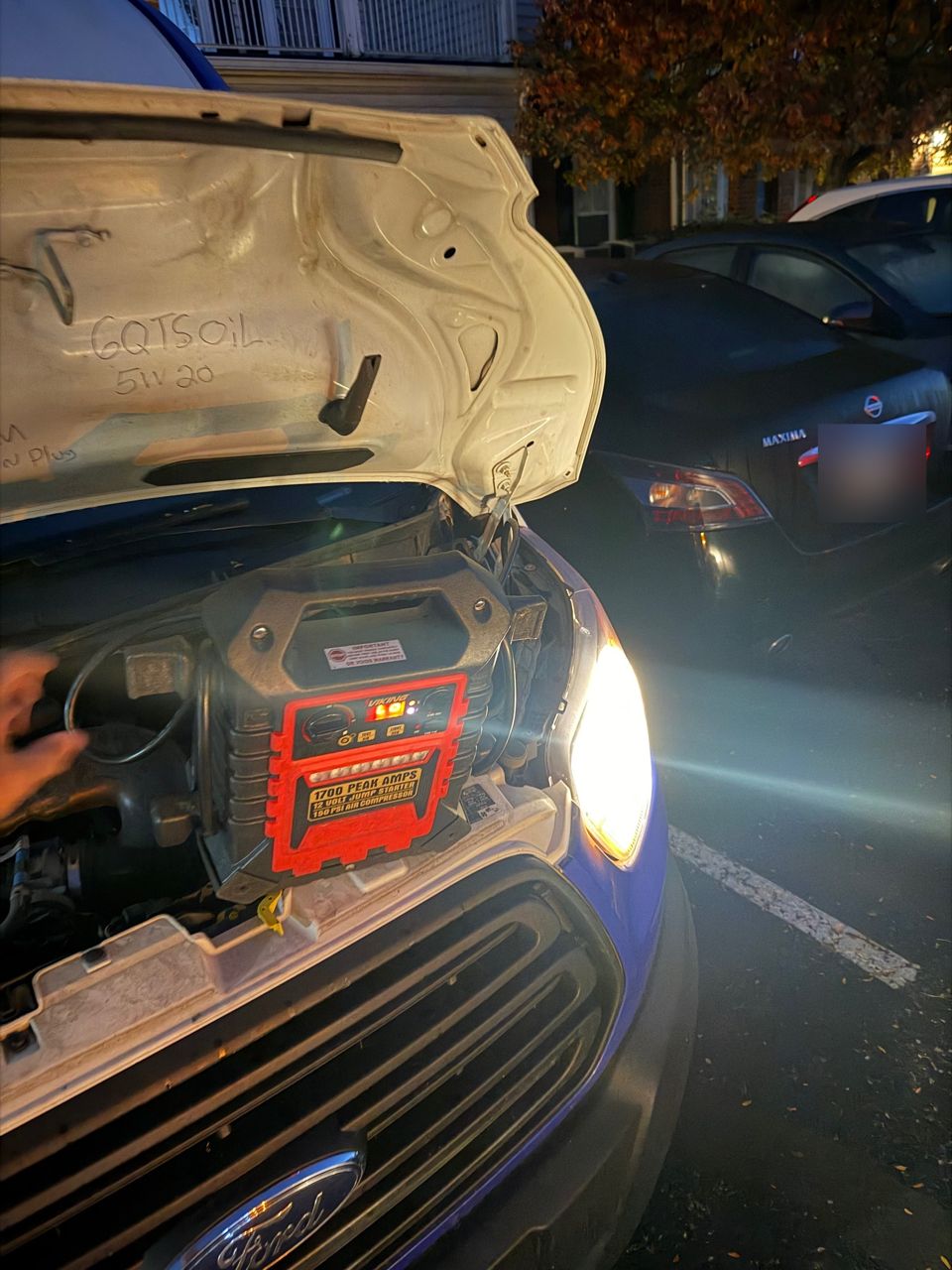
The lesson from this one is simple: know what is draining your battery, and take care of it afterwards. A jump gets you going. If the inverter, a charger or a light stays on again tonight, the battery will be flat again tomorrow, and I would rather you spend that money on coffee.
How to use a power inverter without killing the battery
- Switch it off when the engine goes off. Make it part of parking, like taking the keys. On a work van, put it on the end-of-shift checklist.
- Check whether your socket stays live. On some cars the lighter socket keeps power with the engine off. If yours does, unplug the inverter when you park.
- Run it with the engine on for anything bigger. Schumacher suggests starting the engine every 30 minutes if you must use an inverter with it off.
- Size the inverter to the job. Four Wheel Ask says 150 to 300 watts covers most drivers, and lighter sockets are usually fused at about 10 to 15 amps.
- Wire big inverters to the battery. Schumacher says loads over about 200 watts should be wired directly to the battery, not the lighter socket. Have it fused and installed properly.
- Pick one with a low-battery alarm. Schumacher lists it as a feature worth having, so the inverter warns you before the battery is too low to start the engine.
- Do not run it overnight on the starter battery. For camping or all-night power, Four Wheel Ask points to a separate deep-cycle battery or a portable power station instead.
If you only charge a phone, you probably do not need an inverter at all. A plain USB charger uses far less, and it is one less thing to remember at 8 PM.
What to do after a jump from an inverter drain
Drive for a while, so the alternator can put some charge back. Our guide on how long it takes to charge a car battery explains why a short trip around the block is not enough.
When we jump a car, we test the battery, the alternator and the charging system afterwards. If the battery is worn out, we can replace it on the spot. One flat battery usually recovers, but being run all the way down again and again shortens its life. If it keeps happening with the inverter off, start with what to do about a dead car battery.
And if you have jumper cables and a friendly neighbour, you may not need us at all. Our jump start guide walks you through doing it safely.
Dead battery in Columbus? Jump start help
We jump cars, trucks and work vans at homes, apartment lots and job sites across Columbus. Jump starts are usually $75 to $150 in Columbus, and you see the price before anyone drives to you.
We work 6 AM to 8 PM daily, Eastern Time, and arrive in about 32 minutes on average, depending on traffic, weather and location. See our Columbus jump start service page.
Frequently asked questions
Does a power inverter drain the battery when nothing is plugged in?
Yes, if it is switched on. Many inverters draw a small current just waiting for a load, and over a whole night that can be enough to leave a car or van that will not start. Switch it off or unplug it when you leave the vehicle.
How long can I run an inverter with the engine off?
Not long. Schumacher's example puts a 400-watt load at about 37 amps, enough to flatten a healthy battery in under an hour. Four Wheel Ask suggests keeping engine-off use with small loads to an hour or less.
Can I leave an inverter plugged into the cigarette lighter?
On some cars the lighter socket stays live with the engine off, so a plugged-in inverter can keep drawing power. If yours stays live, unplug the inverter when you park. A socket that switches off with the ignition is safer, but check it rather than assume.
Is it safe to use an inverter while driving?
A small inverter is usually fine with the engine running, because the alternator supplies the power. Schumacher says loads up to about 200 watts can use the lighter socket; larger inverters should be wired directly to the battery.
Will one dead battery from an inverter ruin the battery?
One flat battery usually recovers, but running a starter battery all the way down again and again shortens its life. After a jump, have the battery and charging system tested so you know where it stands.
The bottom line
A power inverter drains your battery any time it is on and the engine is off, and a night is plenty of time to leave you with a van that will not start. Switch it off when you park, keep big loads for when the engine is running, and get the battery tested after a jump.
Van or car won’t start in Columbus?
Call (380) 288-2822, 6 AM to 8 PM daily, Eastern Time. A dispatcher confirms the price and an arrival estimate before anyone heads your way.
Here is to inverters that clock out when you do. Your battery has an early start too.