How to Put Snow Chains on Tires: 7 Steps, Start to Finish
Published Nov 16, 2026 · 7 min read · By Hassan, Owner of Roadmate Services
Snow chains are easy to fit in a dry driveway and much harder in the dark on a snowy hill. Here is how to put snow chains on tires: lay them flat, drape them over the drive wheels, hook the inside then the outside, drive forward about one car length and tighten them again. That is 7 steps, and they get much easier after one practice run.
Then drive gently: 25 to 30 mph at most, according to Les Schwab and YourMechanic, and take them off as soon as the road is clear.
Quick answer: how to put on snow chains at a glance
| Question | Answer | Source |
|---|---|---|
| Which wheels | The drive wheels: front on FWD, rear on RWD, all four or per the manual on AWD | Family Handyman, Les Schwab |
| Where to fit them | On a flat, firm spot well away from traffic | Family Handyman |
| First check | Drive forward about one car length, then re-tighten | Family Handyman, Les Schwab |
| Second check | After about a quarter mile, tighten one more link if needed | YourMechanic |
| Top speed | 25 to 30 mph, or the chain maker's limit if lower | Les Schwab, YourMechanic |
| Bare pavement | Take them off as soon as the road is clear | Family Handyman |
| Rule of thumb | Drive wheels, snug, slow, and only on snow or ice | |
From Family Handyman, YourMechanic and Les Schwab, checked November 2026. General guidance, not Roadmate figures. Your chain maker's instructions come first.
Every set of chains comes with instructions. Most of them are read for the first time by flashlight, which is why this guide exists.
Which tires get chains: FWD, RWD, AWD and 4WD
Chains go on the wheels that push the car. Chains on the wrong axle add weight and noise and do very little for grip.
Front-wheel drive: chains on the 2 front tires
Most sedans, small SUVs and minivans are front-wheel drive. Family Handyman and Les Schwab both put the chains on the front.
Rear-wheel drive: chains on the 2 rear tires
Most pickups in two-wheel-drive mode, many sports cars and some luxury sedans drive the rear wheels. Chains go on the back.
Tire chains for all-wheel-drive vehicles: check the manual
Family Handyman says to chain all four tires on an all-wheel-drive car. Les Schwab says to check the owner's manual, and that is the safer advice: some makers name one axle, and some cars with tight wheel wells only accept low-profile cable chains or socks.
4WD trucks and SUVs: follow the manual too
4x4 manuals differ on which axle gets chains, so follow yours. Look it up while the truck is warm and dry. The manual is the one book in the glovebox that actually has the answer.
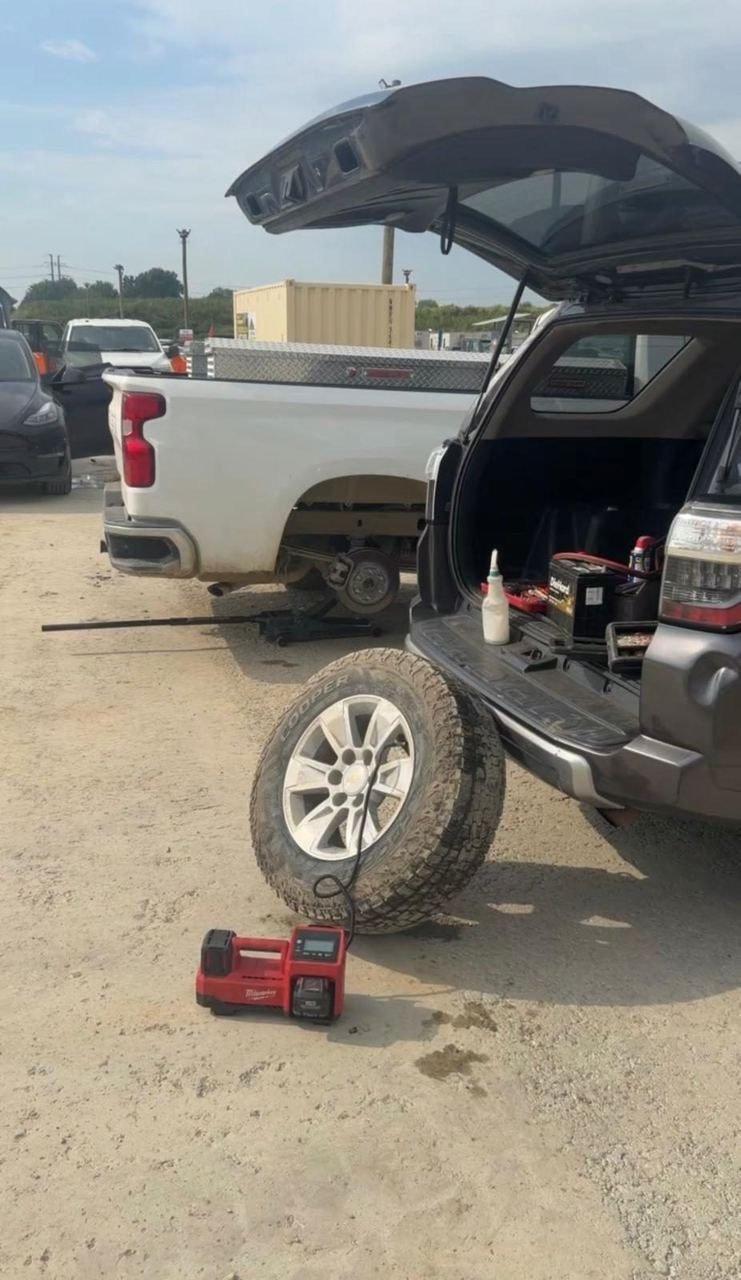
How to put on tire chains in 7 steps
Get safe first. Do not fit chains on a highway shoulder next to moving traffic. If you are on I-70, I-71 or I-270 and the road turns bad, take the next exit and find a parking lot or a wide, flat spot. Hazards on, and wear something bright if you have it.
- Park on firm, flat ground, engine off, parking brake on. Family Handyman makes this step 1 for a reason.
- Untangle the chains and lay them flat next to each drive tire. Find the inside and outside edges and make sure the hooks will face away from the tire. YourMechanic warns that hooks facing in can wear into the tire.
- Drape the chain over the tire so it hangs evenly, with the cross-links straight. YourMechanic says it should cover about three quarters of the way around.
- Connect the inside fastener first, behind the tire. It is the hard one to reach. Kneeling on a mat or a piece of cardboard helps.
- Connect the outside fastener, pulling the chain as snug as you can. Fit the tensioner or the rubber band if your set has one.
- Repeat on the other drive wheel, then drive forward about one car length (Les Schwab says about 15 feet) so the chains settle.
- Re-tighten. Take up the slack, check both sides again, and recheck after about a quarter mile, as YourMechanic suggests. Stop straight away if you hear the chains hitting the car.
How to install cable chains and quick-fit chains: the order is the same, but many quick-fit sets have a built-in tensioner or a red draw chain on the front. Les Schwab's guide walks through that style. The ratchet does the work; your knuckles just supervise.
Driving on snow chains: 25 to 30 mph and off on bare pavement
- Keep it slow. Les Schwab says not to go over 25 mph and YourMechanic says not above 30 mph. If the chain box gives a lower number, use that.
- No sudden moves. Gentle starts, gentle braking, wide turns.
- Take them off on clear roads. Family Handyman says to remove them as soon as you are back on dry pavement. Bare asphalt wears out chains and can damage tires.
- Never drive on a partial set. YourMechanic is clear on that: both drive wheels or none.
Chains make a car sound like a shopping cart full of cutlery. That noise on dry pavement is your cue to pull over and take them off.
Snow tire socks vs chains: which one do you need?
Snow socks are fabric covers that slip over the tire. YourMechanic lists them as a traction aid made of fabric rather than chain or cable. They are light, quick to fit and kind to the wheels, which suits a driver who needs to get home through light snow.
Metal chains bite harder in deep snow and on ice and last much longer. They are heavier, louder and fussier to fit. Cable chains sit in between and fit cars with little room in the wheel well.
If your owner's manual allows only low-profile traction devices, that choice is made for you. If it allows both, pick for the worst road you actually expect, not the one in the movie.
Zip ties as tire chains: last resort only
Heavy plastic zip ties looped through the wheel spokes can give a few seconds of grip to creep out of an icy parking spot. They are not made for traction, they wear through quickly on pavement, and they should never be driven on. Keep real chains or socks in the trunk instead.
Are tire chains legal in Ohio?
Yes, when there is snow or ice on the road. Ohio Revised Code 5589.081 limits studded tires to November 1 through April 15, and it says that rule does not apply to tire chains when there is snow or ice on the street or highway where they are being used.
Do you need chains in Columbus? Most of the time, no. The main roads around Columbus are plowed and treated, and chains on bare pavement do more harm than good. Good winter tires usually do more for a Columbus commute; our winter tires vs all-season guide covers that, and FWD vs AWD in snow explains why the drive wheels matter.
Chains earn their trunk space on a steep, unplowed driveway, a rural road after a big storm, or a ski trip to a state that requires them. Packing them for a drive to Polaris is optimism with extra weight.
6 things to check before winter
- The size matches. Compare the tire size on the sidewall with the sizes on the chain box.
- The manual allows them. Look up traction devices in the index, especially on AWD cars and cars with large wheels.
- You have practised once. A dry run in the driveway turns 7 steps from a puzzle into a routine.
- Nothing is broken or rusted. Check the links, hooks and tensioners from last year.
- The kit is with them: gloves, a mat or cardboard, a flashlight and a rag. Our winter roadside safety tips list the rest.
- You know your drive wheels. Front, rear or all four. Find out now, not in a snowbank.
Chains bought in November and practised in December are the ones that work in January.
Stuck in snow in Columbus anyway? When to call roadside
If the car is already stuck, chains are hard to fit around a buried tire. Our guide to a car stuck in snow covers how to get out safely, and how to drive on black ice covers what to do if you start to slide.
What Roadmate does in Columbus, 6 AM to 8 PM daily:
- Winch-outs from snow, with a winch or a strap, estimated at $150 to $300 per hour.
- Slide-off calls during ice storms, once everyone is safe.
- Packed snow and ice knocked out of the wheels, which can make a car shake after a storm.
- Flat tires changed to your spare or repaired on site when the tire can be fixed, through our Columbus tire change service.
If anyone is hurt, or the car is in a lane of traffic, call 911 first. If you cannot stay warm, call 911 too.
Frequently asked questions
Do snow chains go on the front or back tires?
On the drive wheels. Front-wheel-drive cars take chains on the front, rear-wheel-drive cars on the back. Family Handyman says to chain all four tires on an all-wheel-drive car, and Les Schwab says to check the owner's manual, so read yours first.
How fast can you drive with snow chains on?
Slowly. Les Schwab says not to go over 25 mph and YourMechanic says not above 30 mph. Your chain maker prints its own limit on the box; use whichever number is lower.
Are tire chains legal in Ohio?
Yes, on snow or ice. Ohio Revised Code 5589.081 limits studded tires to November 1 through April 15, and it says the rule does not apply to tire chains when there is snow or ice on the road. Take them off once the pavement is clear, because bare roads wear the chains and can damage the tires.
Are snow socks better than chains?
They do a different job. Snow socks are fabric covers that are lighter and quicker to fit, which suits light snow and getting home. Metal chains grip harder in deep snow and on ice and last longer. Check your owner's manual, since some cars only allow low-profile traction devices.
Can you put chains on an all-wheel-drive car?
Usually, if the manual allows it. Some AWD makers want chains on all four tires, others name one axle, and some cars with tight wheel wells only accept low-profile cable chains or socks. The owner's manual has the final word.
Do zip ties work as tire chains?
Only as a last resort to creep out of a parking spot. Plastic ties are not made for traction and wear through quickly on pavement. Do not drive on them, and do not count on them in place of real chains or socks.
The bottom line
Put snow chains on the drive wheels, hook the inside first and the outside second, drive forward a car length and tighten again. Keep under 25 to 30 mph, take them off on bare pavement, and check the owner's manual on an AWD car. In Ohio they are allowed on snow or ice, and around Columbus most drivers need them only for unplowed roads.
Stuck in snow or a flat tire in Columbus?
Call (380) 288-2822, 6 AM to 8 PM daily, Eastern Time. We arrive in about 32 minutes on average, depending on traffic, weather and location, and the dispatcher confirms the price before anyone heads your way.
Here is to snug chains, slow miles and a quiet ride once the plows have done their job.