How to Check Tire Pressure and Put Air in Your Tires
Published Oct 23, 2026 · 6 min read · By Hassan, Owner of Roadmate Services
Tires lose air the way phones lose charge: slowly, quietly, and never on a day that suits you. Here is how to check tire pressure: find the PSI on the sticker in the driver’s door jamb, check the tires cold, press a gauge onto each valve, add or let out air to match the sticker, recheck, and put the caps back on.
Quick answer: checking and filling tires at a glance
| Step | What to do | Source |
|---|---|---|
| Find your PSI | Sticker on the driver's door jamb, or the owner's manual | AAA |
| When to check | Cold: before driving, or after about 3 hours parked | AAA |
| Check | Press the gauge straight onto the valve until the hiss stops | O'Reilly |
| Add air | Short bursts, recheck after each one | O'Reilly |
| Let air out | Press the valve pin briefly, then recheck | O'Reilly |
| Too low | More than 5 PSI under the sticker, or the TPMS light is on | O'Reilly, NHTSA |
| In short | Sticker pressure, checked cold, once a month | |
Sources: AAA, O’Reilly Auto Parts and NHTSA. Checked October 2026.
What PSI should your tires be?
Find it on the door jamb, not the tire
Open the driver’s door and look for a sticker on the frame. It lists the cold pressure for the front and rear tires. No sticker? The owner’s manual has the number.
The number molded into the tire sidewall is the most the tire can safely hold. It is the tire’s limit, not its wish. Most recommended pressures fall between 30 and 35 PSI, says AAA, but your sticker decides.
Normal tire pressure for an SUV or truck
There is no single normal number. Pressures for SUVs and trucks may be higher than for cars, and the front and rear can differ, especially on pickups built to carry a load. Check the sticker on your own door.
Two SUVs that look like twins in a parking lot can want different numbers. Trust the sticker, not the family resemblance.
How to check tire pressure: 5 steps
- Start with cold tires: before you drive, or after the car has been parked for about three hours. Warm tires read high.
- Unscrew the valve cap and put it in your pocket, where it cannot roll under the car.
- Press the gauge straight and firmly onto the valve until the hissing stops.
- Read the number and compare it with the sticker.
- Repeat on all four tires, then the spare. O’Reilly notes that spares often need about 60 PSI, more than some gauges can read.
Which tire gauge to use
A stick gauge is cheap and needs no battery; dial and digital gauges are easier to read in poor light. Keep one in the glove box with the rest of your emergency car kit. A tire gauge is the cheapest thing in your car that can save a tire.
How to put air in tires at a gas station
- Park so the hose reaches all four tires. Not every station still has an air machine.
- If the machine lets you set a target PSI, set it to your sticker number.
- Start the machine, take the first valve cap off and press the hose chuck straight onto the valve.
- Add air in short bursts, then check with your own gauge. Repeat until you reach the sticker number.
- Do the other tires, then put every cap back on.
If you drove to the station, the tires are warm and read high. AAA’s advice is to fill to 4 PSI above the recommended pressure, then check again once the tires have cooled for about three hours and let out any extra.
Station machines tend to take your quarters and your patience at the same time. Bring your own gauge.
How to put air in a tire with a portable inflator
A 12-volt or cordless inflator lets you fill up in your driveway. Attach its hose to the valve, set the target PSI and let it run; many stop on their own. Check the result with your gauge.
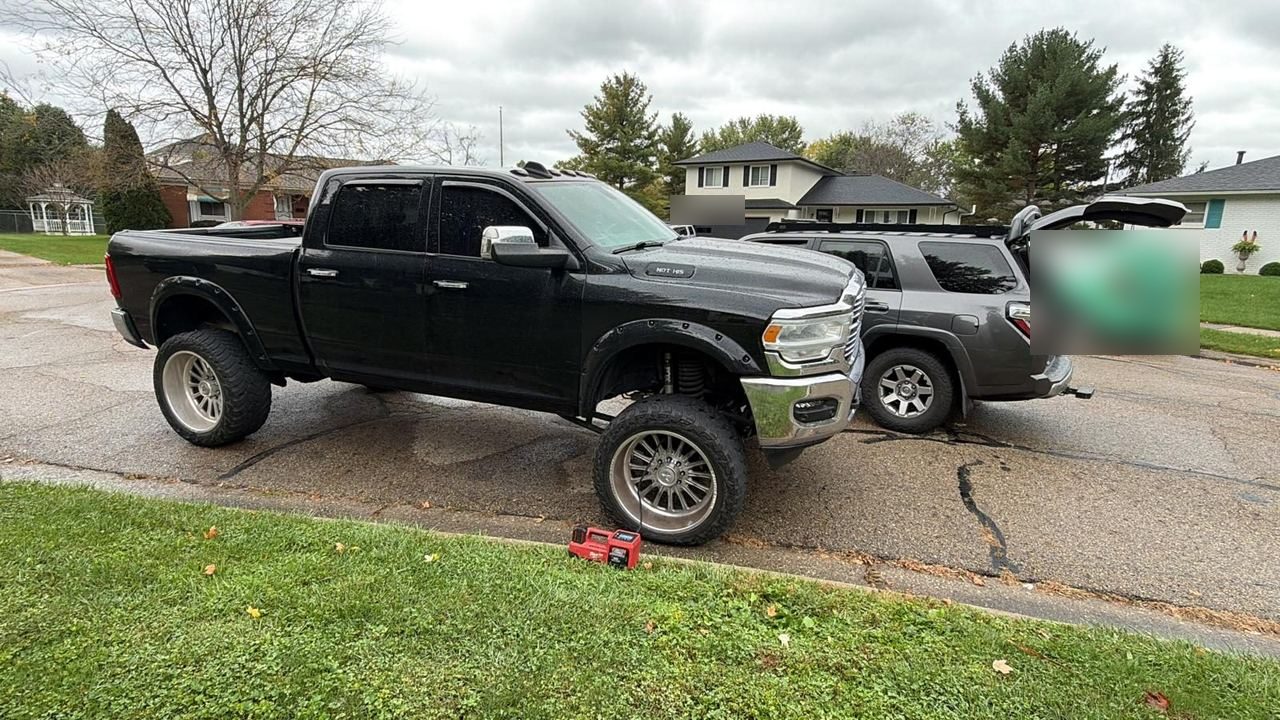
How to let air out of a tire
Overfilled? Press the small pin in the middle of the valve for a second or two. Many gauges have a nub on the back for this; a fingernail works too. O’Reilly warns not to bend the pin.
Check after each short press. It is the only part of car care where a hissing noise is good news.
What tire pressure is too low?
Anything under the sticker number is low. O’Reilly sorts it into tiers:
| Below the sticker | What it means |
|---|---|
| 1 to 5 PSI under | Safe to drive on, to the nearest air |
| Up to 10 PSI under | Worse fuel economy, weaker emergency handling, shorter tire life |
| 11 to 20 PSI under | All of the above, and the tire punctures more easily |
| More than 20 PSI under | Risk of a blowout or the tire rolling off the rim |
The tire pressure monitoring system (TPMS) steps in late. Under the federal rule, FMVSS 138, the light must come on when a tire is 25 percent or more below the sticker pressure. On a 35 PSI car, that is about 26 PSI. Treat the light as a smoke alarm, not a reminder. A flashing light means something else; see what a flashing tire pressure light means.
How often should you check tire pressure?
NHTSA says at least once a month and before long trips. AAA notes that tires can lose up to 3 PSI a month on their own, and low tires cost you at the pump: about 0.2% in gas mileage for every 1 PSI drop, according to fueleconomy.gov.
Temperature matters too. AAA puts it at 1 to 2 PSI for every 10-degree drop, so the first cold morning of fall often brings the light on; more in tire pressure in cold weather. The first of the month works well as a reminder: check the tires, then pay the rent.
Tire keeps losing air?
If one tire is low again a day or two after filling, more air is not the fix. The usual causes are a nail in the tread, a leaking valve or a poor seal at the rim. Start with how to find a slow leak in a tire, then see which punctures can be repaired and how long a tire plug lasts.
A tire that wants air every morning is not low maintenance. It is trying to tell you something.
Low tire and no air nearby in Columbus
Not everything is a roadside job, and we will say so. A tire a few PSI low is a quick stop at an air machine. A tire that will not hold air, or no air anywhere near you, is where we come in.
If a tire goes soft on I-70, I-71 or I-270, get safe, then call. Take the next exit if you can. If you cannot, pull well onto the shoulder, turn on your hazards and stay buckled in. Do not try to fill or change a tire on the traffic side.
In Columbus, a technician can come to you and:
- Inflate low tires that are not flat and reset the TPMS light: quote by phone
- Plug a repairable puncture on site: estimated $75 to $150
- Fit your spare: estimated $85 to $175
We work 6 AM to 8 PM daily and arrive in about 32 minutes on average, depending on traffic, weather and location. See our mobile tire service in Columbus.
Frequently asked questions
Is 40 PSI too high for tires?
For most cars, yes: most call for 30 to 35 PSI. Some SUVs, trucks and spares run higher, so check the door-jamb sticker, and never exceed the sidewall maximum.
How do you check tire pressure at a gas station?
Use your own gauge if you can; station gauges get knocked around and can read wrong. Tires warmed by the drive read high, so fill a little over and recheck once they cool.
Can I drive with low tire pressure?
A few PSI low, yes: drive gently to the nearest air. A tire that looks flat or drops again soon after filling should not be driven far.
What is the normal PSI for a tire?
There is no single number. Most cars call for 30 to 35 PSI, and SUVs and trucks may be higher. The right number for your car is on the driver's door jamb.
How do you put air in a tire without a gauge?
Use the gauge built into the air machine or your portable inflator. Do not judge by eye: a tire can be well under the right pressure before it looks low.
Tire looks flat already? Read can you drive on a flat tire.
The bottom line
To check tire pressure, use a gauge on cold tires and match the sticker in the driver’s door jamb, not the sidewall. Add air in short bursts, let it out with the valve pin, and recheck. Do it monthly, and treat a tire that keeps dropping as a leak.
Low tire in Columbus and no air pump nearby?
Call (380) 288-2822, 6 AM to 8 PM daily, Eastern Time. A dispatcher confirms the price and an arrival estimate before anyone heads your way.
Here is to round tires and a gauge that agrees with your door sticker.